

Published
At a glance
- About 110,218 Australians went rock climbing, abseiling or caving in 2025, and 130,277 took part in sport climbing1.
- New South Wales has the most climbers, with 31% of adult participants1.
- People aged 25–34 are the largest age group, and about 59% of adult climbers who identify as male or female are male1.
- Adult participation was broadly steady between 2024 and 2025: the 7.2% rise is within AusPlay's margin of error1.
- Coroner data record 19 rock climbing deaths in Australia between 2000 and 20192.
- A casual adult day pass at a climbing gym costs about A$24–2634.
- Since October 2026, about 80 climbs at Mount Arapiles have been closed, but climbers can still use all but three of its more than 150 climbing areas5.
How popular is rock climbing in Australia?
About 110,218 Australians (adults and children) went rock climbing, abseiling or caving in the 2025 calendar year1, and 130,277 took part in sport climbing, which AusPlay counts as a separate activity.
- New South Wales has the most climbers, with 31% of adult participants1.
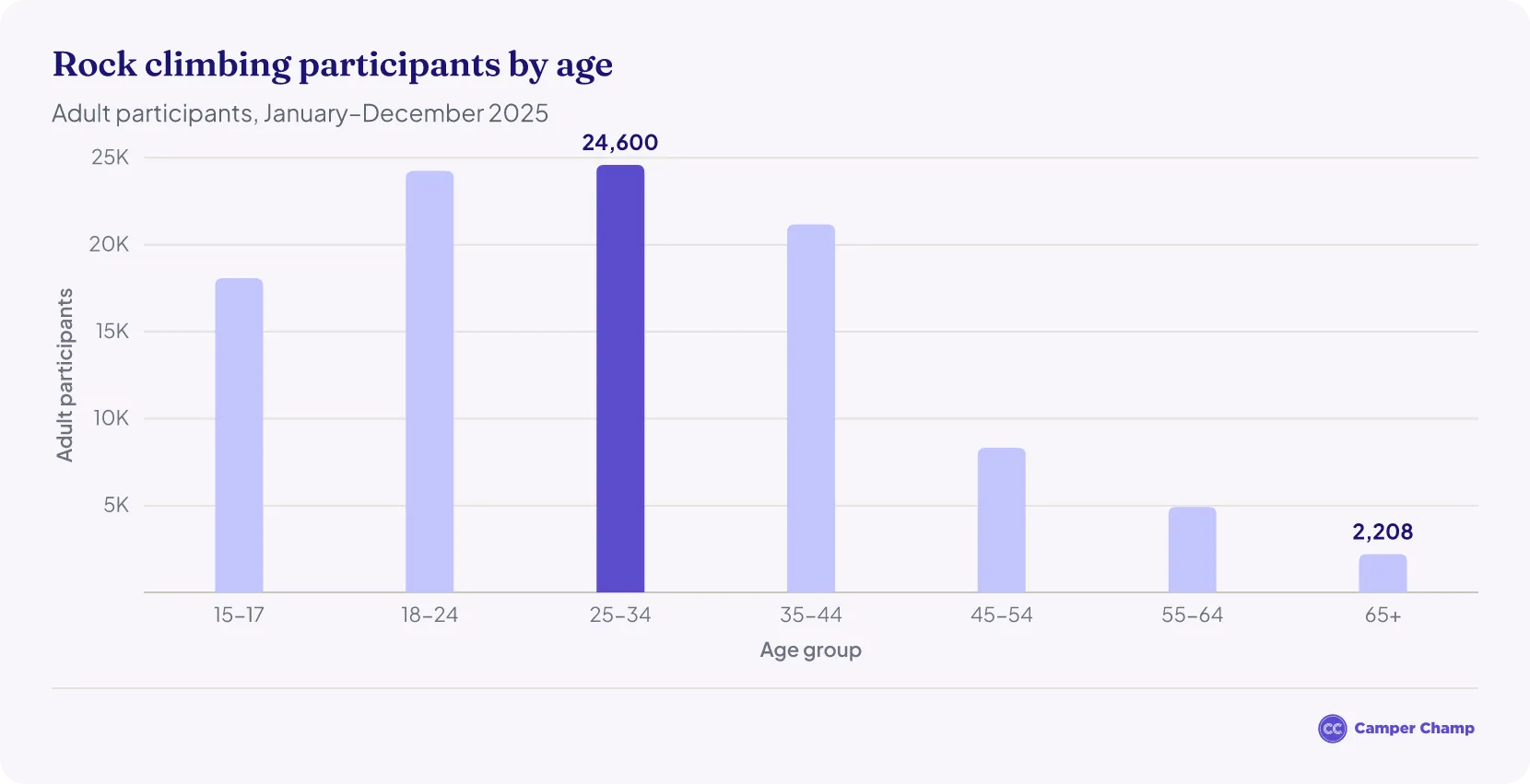
- People aged 25–34 are the largest age group, with 24,600 participants1.
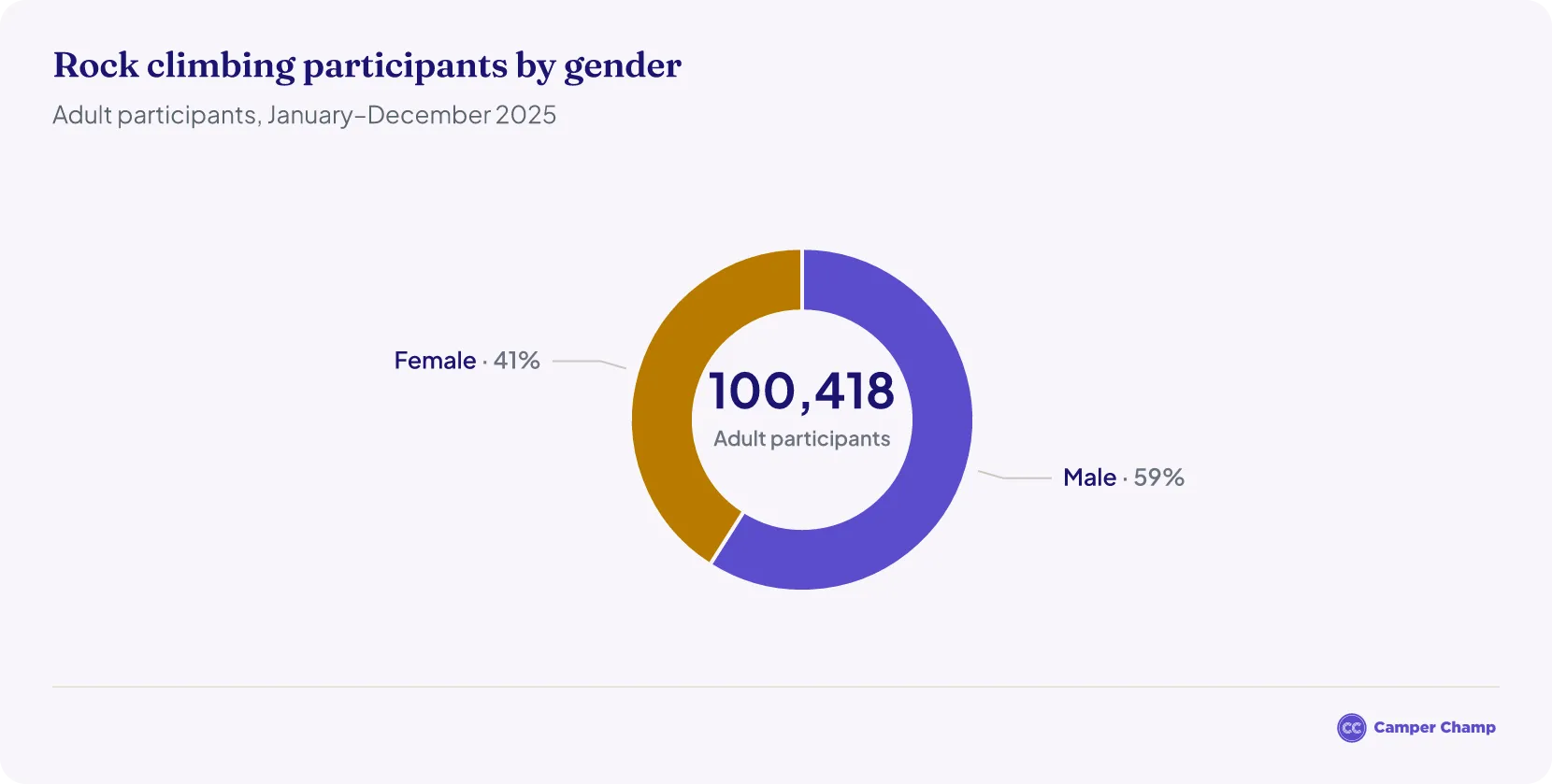
- About 59% of adult climbers are male and 41% female, of those identifying as male or female1.
AusPlay moved to an online survey in July 2023, so figures from 2024 onwards cannot be compared directly with the higher 2016–2022 estimates1. These are the latest figures available: AusPlay's next release, covering July 2025 to June 2026, is due in late October 2026.
How many people rock climb in Australia? (2016–2025)
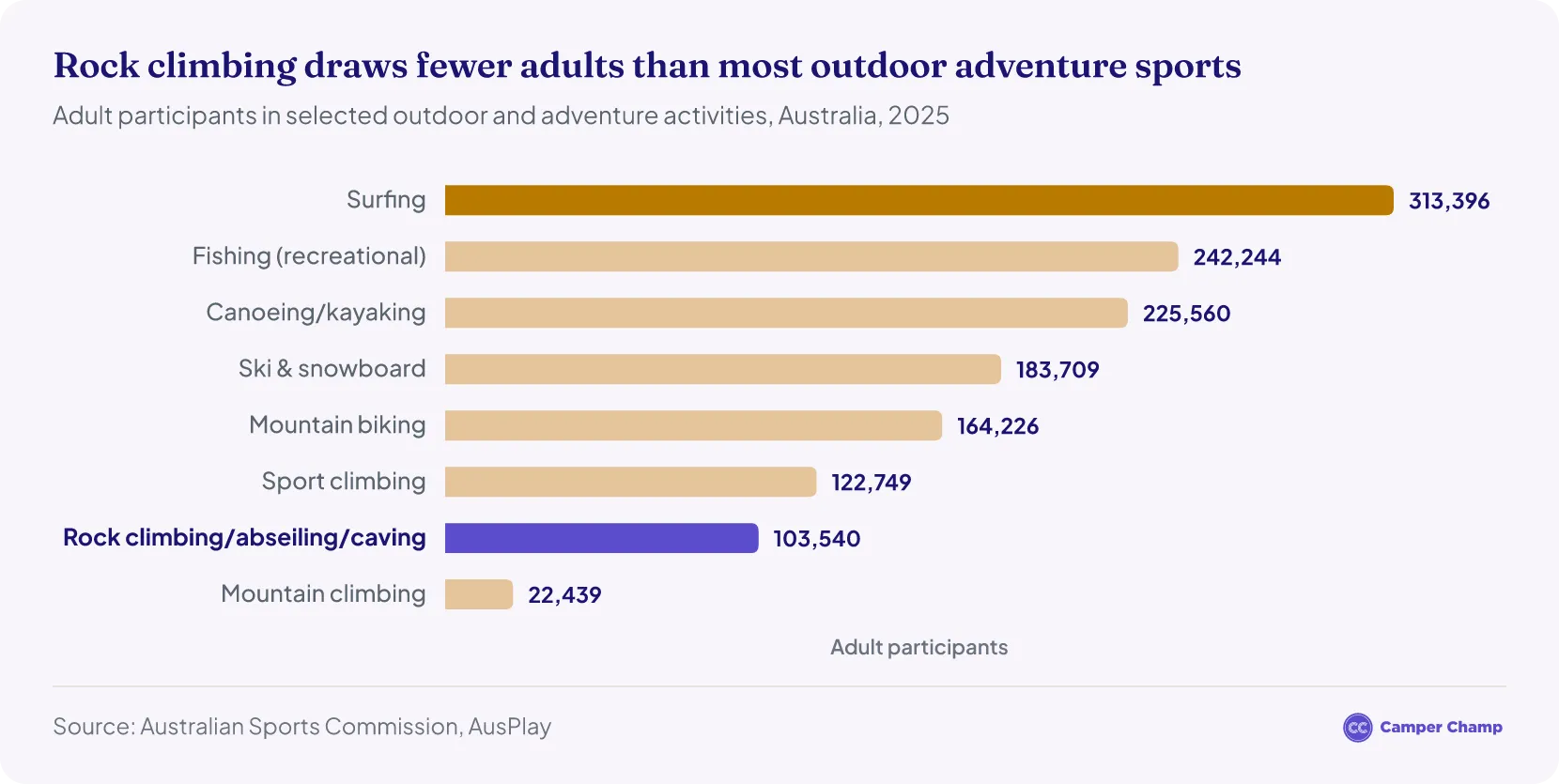
A total of 110,218 participants engaged in rock climbing/abseiling/caving in Australia in the 2025 calendar year1. This includes 103,540 participants aged 15 and above and 6,679 children aged 14 and below. AusPlay counts sport climbing as a separate activity: 122,749 adults and 7,528 children took part in 2025, a total of 130,277, while 22,439 adults went mountain climbing. Children's figures cover organised climbing outside school hours.
- Rock climbing reached about 212,400 participants in 2019, an 11.9% increase from the previous year (189,800)6.
- Despite pandemic restrictions, participation jumped 31.4% to about 279,100 participants in 20206.
- By 2022, total participation had increased to 333,900, a 19.6% growth since 20206.
- Figures from 2024 onwards come from AusPlay's new online survey and, as per the Australian Sports Commission, are not directly comparable to 2016–2022; there is no calendar-year figure for 2023, when the survey changed method mid-year1.
- Participation was broadly steady, at 107,172 in 2024 and 110,218 in 20251. The 2.8% rise is smaller than AusPlay's margin of error for estimates of this size.
Which state has the most rock climbers in Australia?
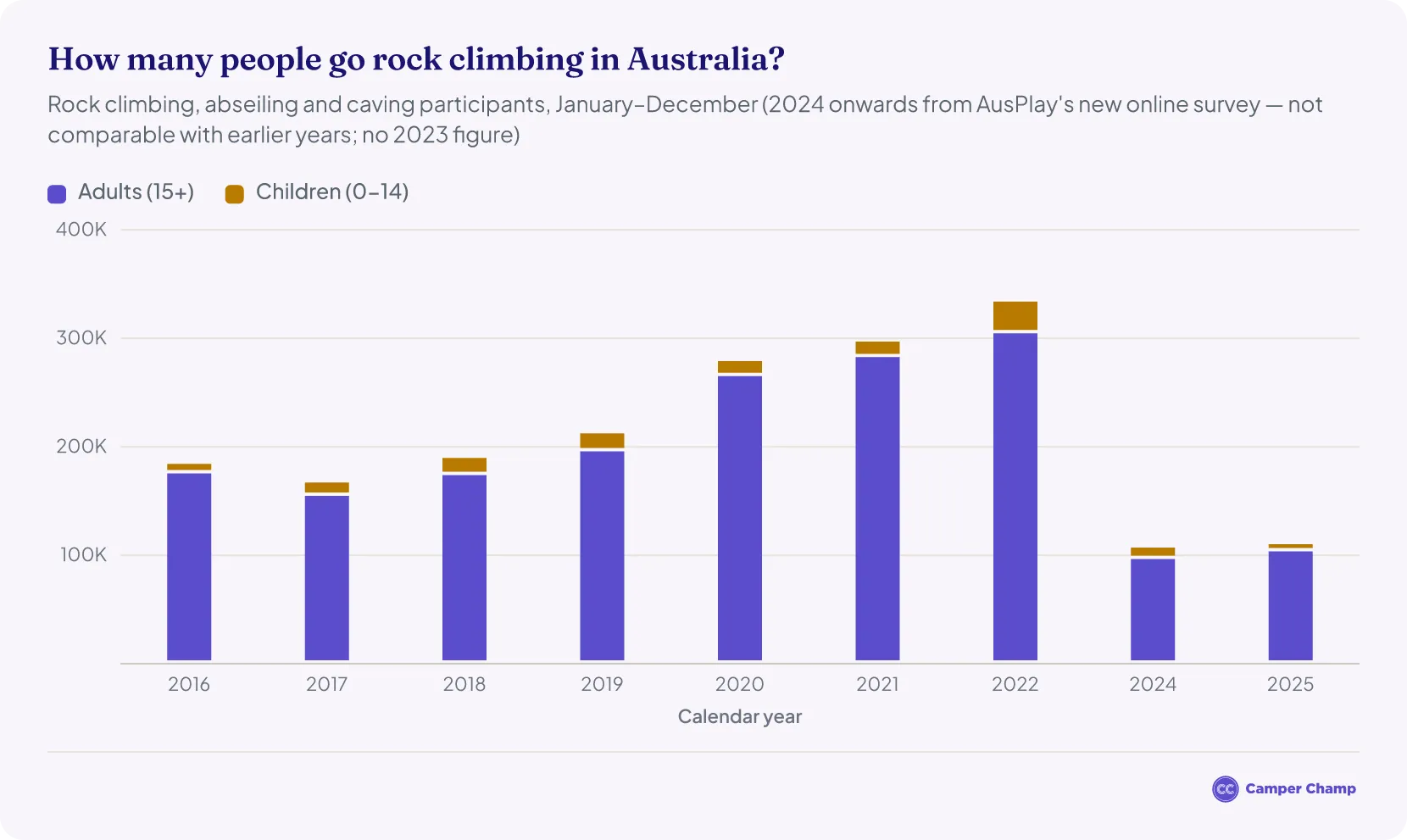
New South Wales has the highest rock climbing participation, representing 31% of Australia's adult climbing community in the 2025 calendar year1.
- Victoria ranks second, with 25.6% of national participation1, while Queensland follows with 22.2% of participants.
- Western Australia accounts for 13% of the national climbing community1.
- Tasmania represents 2.1% of Australia's climbing population1, while South Australia has 2.6% of the national participation share.
- The Australian Capital Territory accounts for 2.3% of climbing participants despite its small population1.
- The Northern Territory accounts for 1.1% of the national total1.
The shares for Tasmania, South Australia, the ACT and the Northern Territory rest on estimates of only 1,200–2,700 climbers each, with margins of error of roughly ±85% to ±125%, so treat them as rough and the order among these four as unreliable.1
How does rock climbing compare with other outdoor sports?
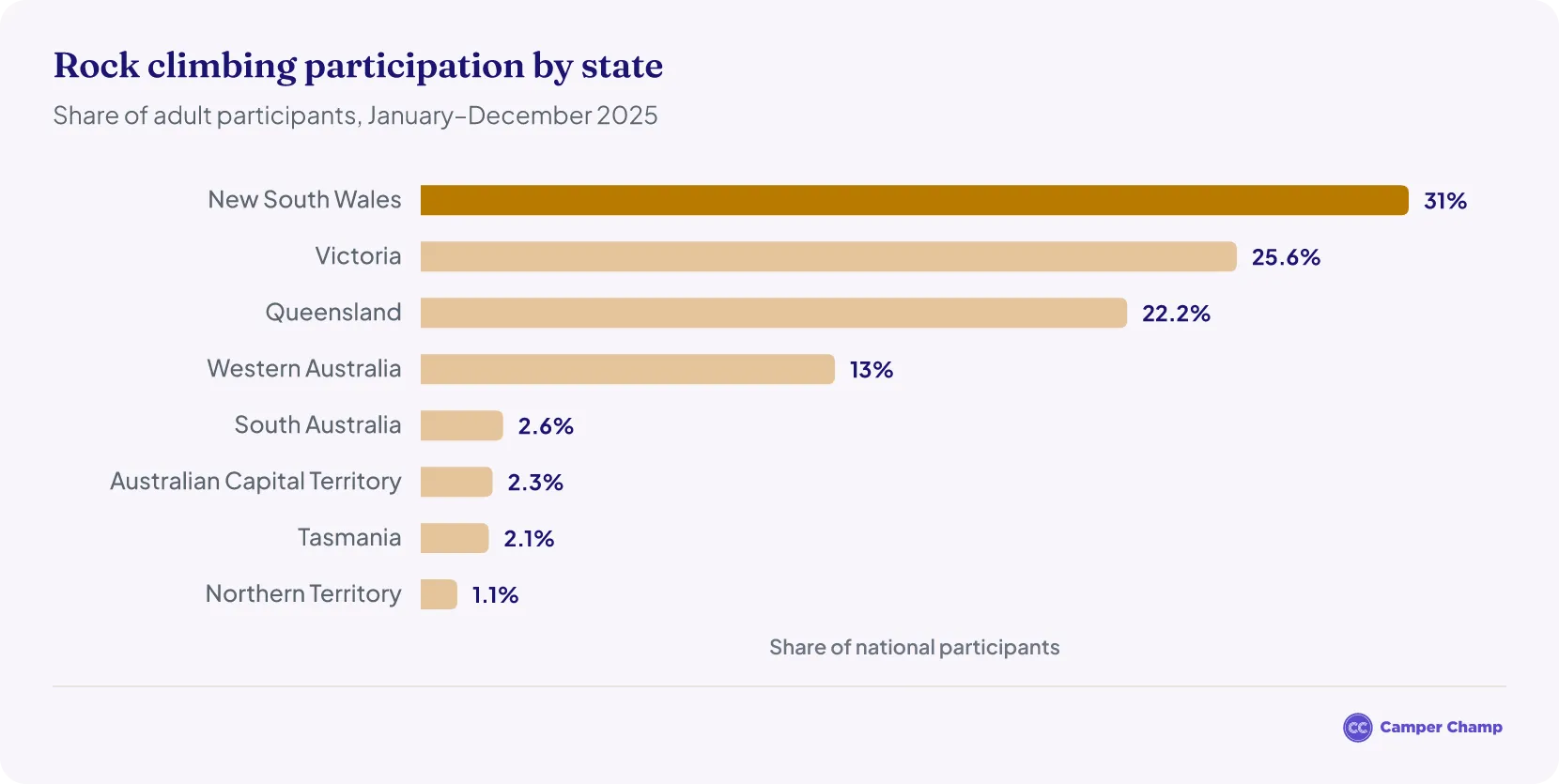
Rock climbing, abseiling and caving ranked 43rd of 142 sports and activities by adult participation in 2025, with 0.5% of adults taking part, while sport climbing ranked 40th1. Bushwalking is about 38 times more popular, and mountain biking draws about 60% more adult participants than rock climbing.
| Activity | Adult participants (15+) | Share of adults | Rank (of 142 activities) |
|---|---|---|---|
| Bush walking | 3,953,952 | 17.5% | 3 |
| Cycling | 1,877,339 | 8.3% | 6 |
| Surfing | 313,396 | 1.4% | 19 |
| Fishing (recreational) | 242,244 | 1.1% | 24 |
| Canoeing/kayaking | 225,560 | 1.0% | 25 |
| Ski and snowboard | 183,709 | 0.8% | 32 |
| Mountain biking | 164,226 | 0.7% | 34 |
| Sport climbing | 122,749 | 0.5% | 40 |
| Rock climbing/abseiling/caving | 103,540 | 0.5% | 43 |
| Mountain climbing | 22,439 | 0.1% | 73 |
How much does rock climbing cost in Australia?
A casual adult day pass at a major Australian climbing gym costs A$24–26, and an ongoing membership about A$31–39 a week or A$145–160 a month (prices as of October 2026). AusPlay does not report spending by activity, so there is no official figure for how much Australians spend on climbing in total.
- Urban Climb (Brisbane, Melbourne, Townsville and Adelaide) charges A$26 for an adult rock-up session; memberships cost A$31 a week on a 12-month contract, A$33 on a 6-month contract or A$39 with no contract4.
- 9 Degrees (Sydney and Brisbane) charges A$26 for a casual visit and A$160 a month for a rolling membership, or A$1,550 prepaid for 12 months7.
- BlocHaus (Melbourne, Sydney and Canberra) charges A$26 for an adult day pass, A$38 a week for its All-Haus membership, or A$1,510 for 12 months8.
- Northside Boulders (Melbourne) charges A$24 for general admission and A$160 for a monthly membership3.
- Climbers visiting Mount Arapiles spent an estimated A$3.4 million and those visiting the Grampians about A$3.5 million in 20189, with total direct and indirect benefits to each region of A$12.3 million and A$11.9 million respectively.
Who goes rock climbing in Australia? Age and gender
Rock climbers by age group (2025)
People aged 25–34 represent the largest age group among rock climbers, with 24,600 participants, followed closely by those aged 18–24 with 24,246 participants1.
Male vs female rock climbers in Australia (2025)
Males dominated rock climbing participation, accounting for 59,263 in the 2025 calendar year, approximately 59.0% of climbers aged 15 and over who identify as male or female1.
- Female participants numbered 41,155 in the 2025 calendar year, approximately 41.0% of climbers aged 15 and over who identify as male or female1. AusPlay counts non-binary and self-described climbers in its total but does not report them separately.
Why do Australians go rock climbing?
- Community and social connection are frequently cited as primary reasons people engage in rock climbing.
- Physical fitness and strength development attract many participants seeking full-body workouts.
- Problem-solving and mental challenge appeal to climbers who enjoy the puzzle-like nature of routes.
- Adventure and outdoor experiences motivate many outdoor climbers seeking connection with nature.
- Personal achievement and goal-setting drive climbers to progress through increasingly difficult routes.
- Stress relief and mental wellbeing benefits are recognised by many regular climbers.
How often do Australians go rock climbing?
AusPlay does not publish how often people climb, so there is no official figure for climbing frequency in Australia.
- Gym climbers tend to keep regular weekly sessions, which is why most gyms sell weekly and monthly memberships rather than single visits.
- Outdoor climbing trips usually happen on weekends or longer holidays, and follow the climbing seasons in each region.
Is rock climbing dangerous? Injury statistics in Australia
Deaths from rock climbing are rare in Australia. Coroner data record 19 rock climbing deaths and 6 abseiling deaths between July 2000 and December 2019, out of 1,192 unintentional injury deaths in sport and recreation over the same period2.
- Rock climbing accounted for 26% of the 73 adventure sport deaths in that period, or roughly one death a year2.
- The Australian Institute of Health and Welfare does not report climbing injuries on their own. It groups climbing with abseiling, mountaineering, hiking and rafting as "adventure and extreme sports", which led to 335 hospital stays in 2011–12, 0.9% of all sports injury hospitalisations10.
Best rock climbing locations in Australia
Most popular rock climbing areas in Australia
Australia's best-known climbing areas are in Victoria and New South Wales, with the Blue Mountains in New South Wales among the most popular.
- Mount Arapiles, Victoria is Australia's traditional climbing mecca, with about 51,000 climbing days in 20189 and roughly 3,300 routes11.
- Grampians (Gariwerd), Victoria offers world-class sandstone climbing, with about 49,000 climbing days in 20189, although parts of the park have been closed to climbers since 2019.
- Nowra, NSW provides a sport climbing paradise on limestone cliffs along the Shoalhaven River.
- Freycinet (Coles Bay), Tasmania features exquisite granite climbing with ocean backdrops, particularly popular during spring and autumn.
Best rock climbing areas by experience level
Australia offers rock climbing terrain suitable for all skill levels, from beginner-friendly indoor gyms to expert-only outdoor routes.
For beginners
- Indoor climbing gyms provide controlled environments with graded routes and safety systems ideal for new climbers.
- Morialta Conservation Park, South Australia offers accessible top-roping options 20 minutes from Adelaide.
- Urban crags like Lindfield Rocks in Sydney provide entry-level bouldering opportunities.
- Kangaroo Point in Brisbane features well-bolted routes with easy access for newcomers.
For intermediate climbers
- Nowra, NSW offers hundreds of sport routes across various grades accessible to progressing climbers.
- You Yangs Regional Park, Victoria provides a range of intermediate-level climbing options.
- Most major climbing destinations feature substantial selections of middle-grade routes suitable for developing climbers.
- Urban Climb and similar gyms across major cities offer structured progression through intermediate grades.
For advanced/expert climbers
- Taipan Wall in the Grampians is famous for its hard sport routes, but it is currently closed to climbers to protect cultural heritage12.
- Mount Arapiles offers challenging traditional climbing that has tested generations of elite climbers.
- Moonarie, South Australia provides remote, committing multi-pitch routes for experienced trad climbers.
- Point Perpendicular, NSW features dramatic sea cliff climbing requiring advanced skills and equipment.
Can you still climb at Mount Arapiles and the Grampians?
Yes, but not everywhere. Parks Victoria announced climbing bans covering about a third of the Grampians (Gariwerd) in March 201913 to protect Aboriginal cultural heritage, and areas including Taipan Wall and the Gallery and Millennium Caves remain off-limits12.
- At Mount Arapiles (Dyurrite), Parks Victoria's 2024 draft plan proposed closing up to 2,000 of the park's roughly 3,300 climbing routes11.
- A revised proposal in July 2026 scaled this back to the full closure of about 100 routes11.
- New access arrangements took effect in October 202614: about 80 climbs are closed and 46 have been rerouted, and climbers can use all but three of more than 150 climbing areas in the park5.
When is the best time to go rock climbing in Australia?
The best climbing season depends on the region: the cooler months suit Queensland, while New South Wales and Victoria are best in spring and autumn, and Tasmania in summer and autumn.
- Indoor climbing is unaffected by the weather, so gyms are where most climbers train year-round.
- Outdoor climbers often follow the seasons, heading north in winter and south in autumn.
| Region | Best time to climb | Why |
|---|---|---|
| Blue Mountains (NSW) | Spring (September–November) and autumn (March–May) | Mild temperatures; winter also suits harder routes |
| Mount Arapiles and the Grampians (Vic) | April–May and September–October | Avoids summer heat and winter rain |
| Queensland | Winter (June–August) | Cooler, drier conditions |
| Tasmania | Summer and autumn (December–April) | Milder temperatures |
Rock climbing and camping in Australia
Do rock climbers go camping?
Many do, because most of Australia's best outdoor crags are hours from the nearest city. At Mount Arapiles, Centenary Park is the only place to camp in the park, with three camping areas: the Pines, the Upper Gums and the Lower Gums15. The Pines sits at the base of the escarpment, right below the climbing cliffs16.
- The 2021 study of climbing at Mount Arapiles and the Grampians counted climbers partly through car surveys at the Pines and the Gums camping areas. It noted that, with camping gear, food and climbing equipment on board, very few climbers' vehicles had room for more than three people9.
- In the Grampians, Parks Victoria campgrounds such as Buandik and Boreang are booked online17.
- Climbing is a niche activity on camping trips overall. Bushwalking, beach visits and exploring national parks are among the top five activities on Australia's 15.2 million caravan and camping trips in 2024, and climbing does not make the top 2018.
Campervan hire in Australia
Climbing gyms and competitions in Australia
How many indoor climbing gyms are there in Australia?
Australia had 46 commercial climbing gyms in 2015, which was more per head of population than the United States at the time19. No official body publishes a more recent national count.
- Major gym networks like Urban Climb operate multiple locations in Brisbane, Melbourne, Townsville and Adelaide.
- Sydney hosts several large facilities including Sydney Indoor Climbing Gym (Villawood and St Peters) and Climb Fit (St Leonards and Kirrawee).
- BlocHaus Bouldering operates dedicated bouldering facilities in Melbourne, Sydney and Canberra.
- Regional cities like Ballarat and Wollongong have gained modern climbing facilities in recent years.
Major Australian rock climbing competitions and events
Australian National Championships are held annually, featuring lead climbing, bouldering, and speed disciplines.
- The Oceania Olympic Qualifier was held at Urban Climb Blackburn in Melbourne on 24–26 November 202320 to decide qualification for the Paris 2024 Olympics.
- Local climbing gyms regularly host competitions, leagues, and festivals to engage the community.
- Grampians Climbing Festival and similar regional events celebrate outdoor climbing culture.
- Australia sent two climbers, Tom O'Halloran and Oceana Mackenzie, to the Tokyo 2020 Olympics, marking the country's first Olympic representation in the sport21.
The future of rock climbing in Australia
Is rock climbing growing in Australia?
Adult participation in rock climbing, abseiling and caving was broadly steady between 2024 and 2025, at 96,605 and 103,540, while children's organised participation fell from 10,567 to 6,6791. The 7.2% adult rise is well within AusPlay's margin of error of about ±17% for estimates of this size, and the children's figures rest on an even smaller sample, so treat both changes with caution.
- Olympic recognition since Tokyo 2020 continues to raise the sport's profile.
- Sport climbing's place on the Brisbane 2032 Olympic program depends on an IOC decision that World Climbing expected in 202622.
- The access restrictions at Mount Arapiles and the Grampians, two of Australia's best-known climbing areas, will shape where Victorian climbers go.
What's next for climbing in Australia?
- Youth participation will continue expanding through school programs, competitive teams, and family-oriented facilities.
- Gender balance is still some way off: women made up about 41% of adult climbers who identify as male or female in 20251.
- Training innovations including app-based programs, MoonBoards, Kilterboards, and other standardised training systems will elevate performance levels.
- Climbing’s cultural mainstream appeal is shifting away from the “extreme sport” label and establishing it as a regular fitness activity.
- Environmental and cultural awareness is increasing, with climbers working collaboratively with land managers and Traditional Owners to ensure sustainable access.
- Competitive climbing will see greater Australian success internationally as training programs develop elite athletes.
- Urban climbing opportunities may expand through public bouldering installations in parks and recreational spaces.
Other resources
- Glamping Statistics in Australia
- Hiking Statistics in Australia
- Mountain Biking Statistics in Australia
References
- AusPlay results — national, state and by-sport data tables (Australian Sports Commission) · ausport.gov.au ↑ b c d e f g h i j k l m n o p q r s t u v w x y z a2 b2
- Injury deaths in Australian sport and recreation: Identifying and assessing priorities for prevention (PLOS ONE, 2021) · journals.plos.org ↑ b c
- Northside Boulders prices · northsideboulders.com ↑ b
- Urban Climb pricing · urbanclimb.com.au ↑ b
- Mount Arapiles-Tooan State Park climbing plan approved (ABC News) · abc.net.au ↑ b
- AusPlay results 2015–2023 (phone survey series) — data tables (Australian Sports Commission) · ausport.gov.au ↑ b c
- 9 Degrees climbing gym prices and info · 9degrees.com.au ↑
- BlocHaus Melbourne pricing · mlb.blochaus.com.au ↑
- 2021 Economic assessment of Rock Climbing in The Grampians & Mt Arapiles (Vertical Life) · verticallifemag.com ↑ b c d
- Australian sports injury hospitalisations 2011–12 (AIHW) · aihw.gov.au ↑
- Parks Victoria plan proposes full closure of about 100 Arapiles climbing routes (ABC News) · abc.net.au ↑ b c
- Rock climbers' celebrations crushed as government confirms Grampians, Arapiles bans (ABC News) · abc.net.au ↑ b
- Grampians National Park becomes battleground as rock climbers banned to protect Aboriginal art (ABC News) · abc.net.au ↑
- New access arrangements confirmed for Dyurrite (Parks Victoria) · parks.vic.gov.au ↑
- Mount Arapiles-Tooan State Park (Parks Victoria) · parks.vic.gov.au ↑
- Centenary Park - Pines Camping Area, Mount Arapiles-Tooan State Park (Parks Victoria) · parks.vic.gov.au ↑
- Buandik Campground, Grampians National Park (Parks Victoria) · parks.vic.gov.au ↑
- Caravan Industry Association of Australia — Caravan and Camping State of Industry 2025 · assets.pc.gov.au ↑
- Australia Buzzes with Bouldering (Climbing Business Journal, 2015) · climbingbusinessjournal.com ↑
- Climbing Olympic Qualification Down Under for Four More Paris 2024 Tickets (World Climbing) · worldclimbing.com ↑
- Sport Climbers Set to Scale Olympic Heights with Tokyo 2020 Selection (Australian Olympic Committee) · olympics.com.au ↑
- Looking Towards the Climbing Future in Brisbane (World Climbing) · worldclimbing.com ↑