

Published
At a glance
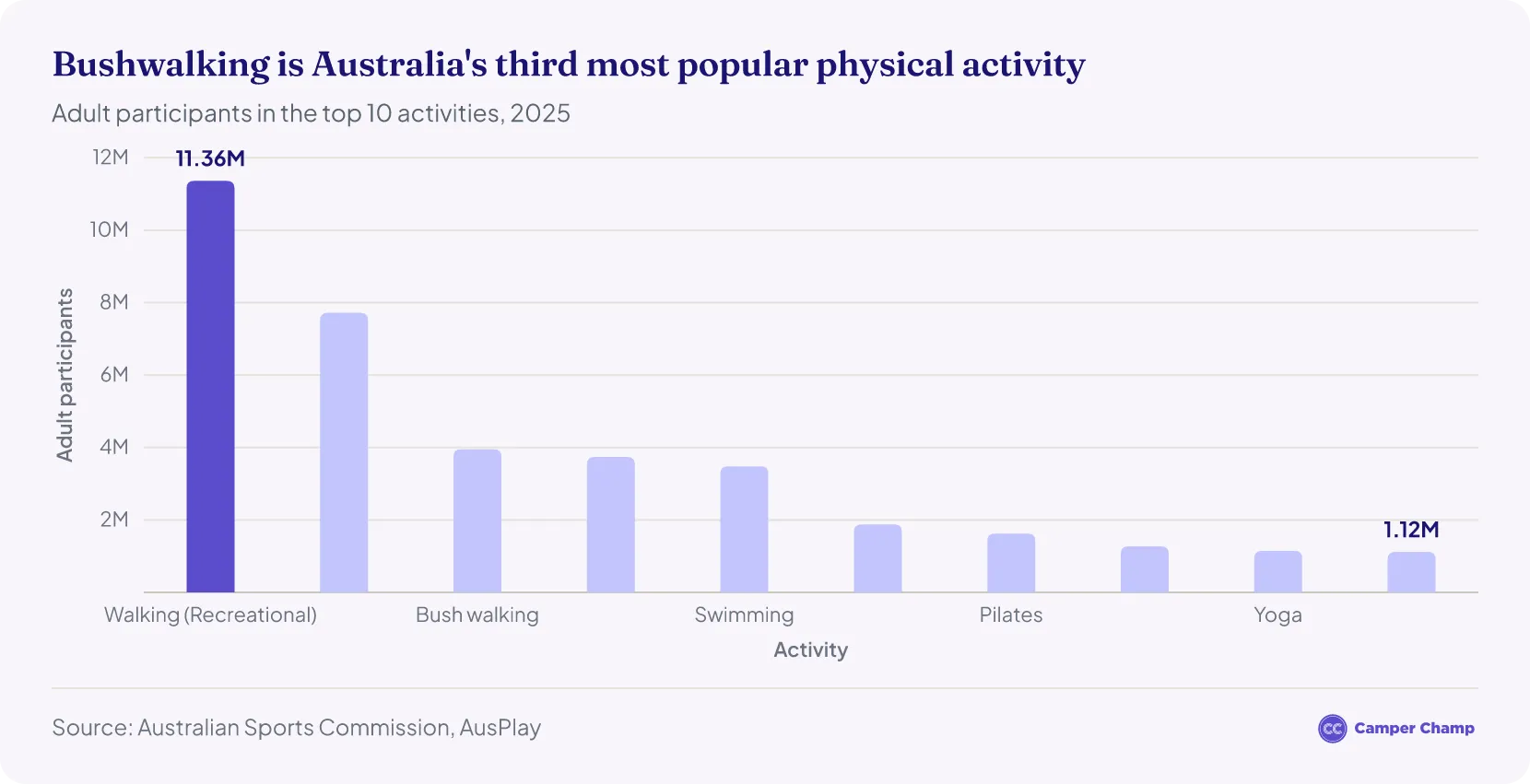
- About 3.95 million Australian adults went hiking or bushwalking in 2025 – 17.5% of all adults – making it the country's third most popular physical activity.1
- That is about 5.7% more than in 2024.1
- New South Wales has the most hikers, about 1.23 million adults, while Tasmania has the highest participation rate at 27.5% of adults.1
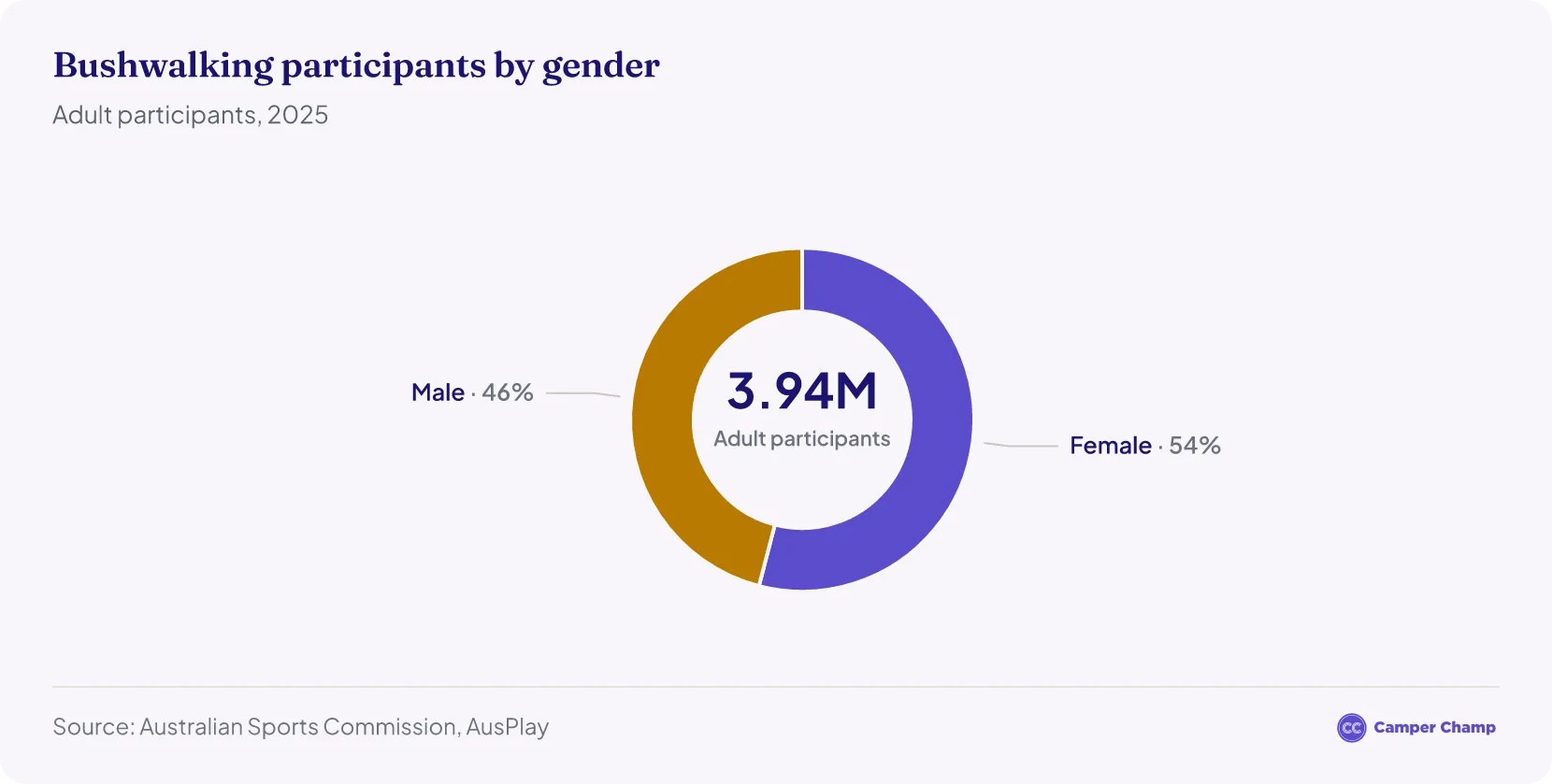
- More women (2.13 million) than men (1.81 million) go hiking, and 35–44-year-olds are the largest age group.1
- The Bondi to Coogee Coastal Walk in Sydney was Australia's most popular hike in 2025.2
- The Bicentennial National Trail is Australia's longest trail at 5,330 km.3
Hiking Participation in Australia (2025)
How many people go hiking in Australia?
A total of 3.95 million people participated in hiking/bushwalking in Australia in 2025, or 17.5% of Australian adults.1 That makes it the 3rd most popular physical activity in Australia.
- AusPlay, the national survey behind these figures, records hiking as bushwalking, the Australian term for walking in natural areas.
Note that figures from 2023–24 onwards cannot be directly compared with 2015–2023 because the Australian Sports Commission changed how the data is collected.
Is hiking growing in Australia?
Hiking participation grew from 3.74 million adults in 2024 to 3.95 million in 2025, a rise of about 5.7%.1 The share of adults who hike rose from 16.9% to 17.5%.
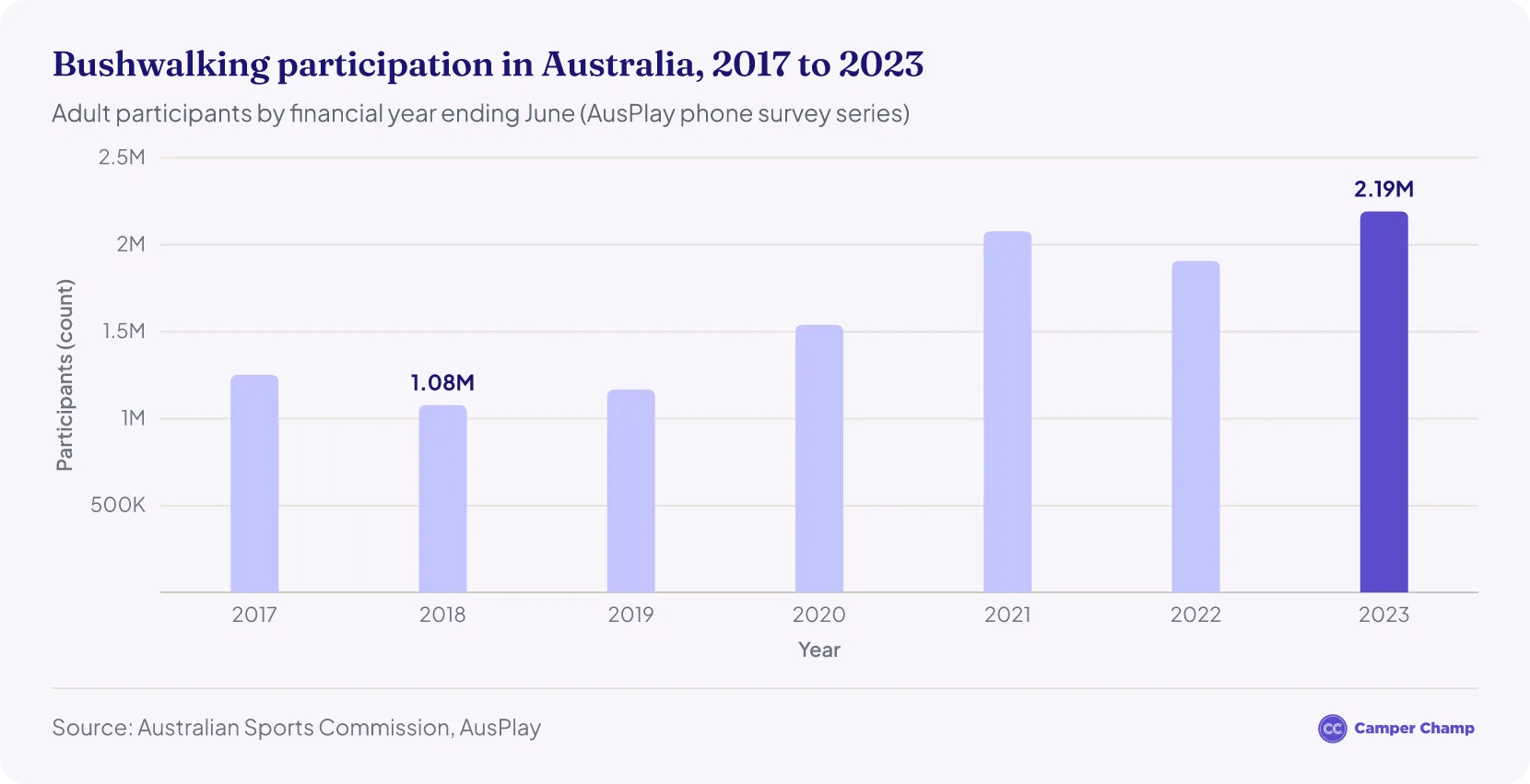
Under the earlier phone survey, about 2.19 million people went hiking in Australia in the year to June 2023.4
- The number of hikers increased from 1.17 million in 2018–19 to 1.54 million in 2019–20, representing a growth of approximately 31.9%.4
- In 2020–21, hiking participation totalled 2.08 million and slightly declined to 1.91 million in 2021–22, a decrease of 8.2%.4
- By 2022–23, hiking participation recovered to 2.19 million, a 14.9% increase on 2021–22.4
Which state hikes the most?
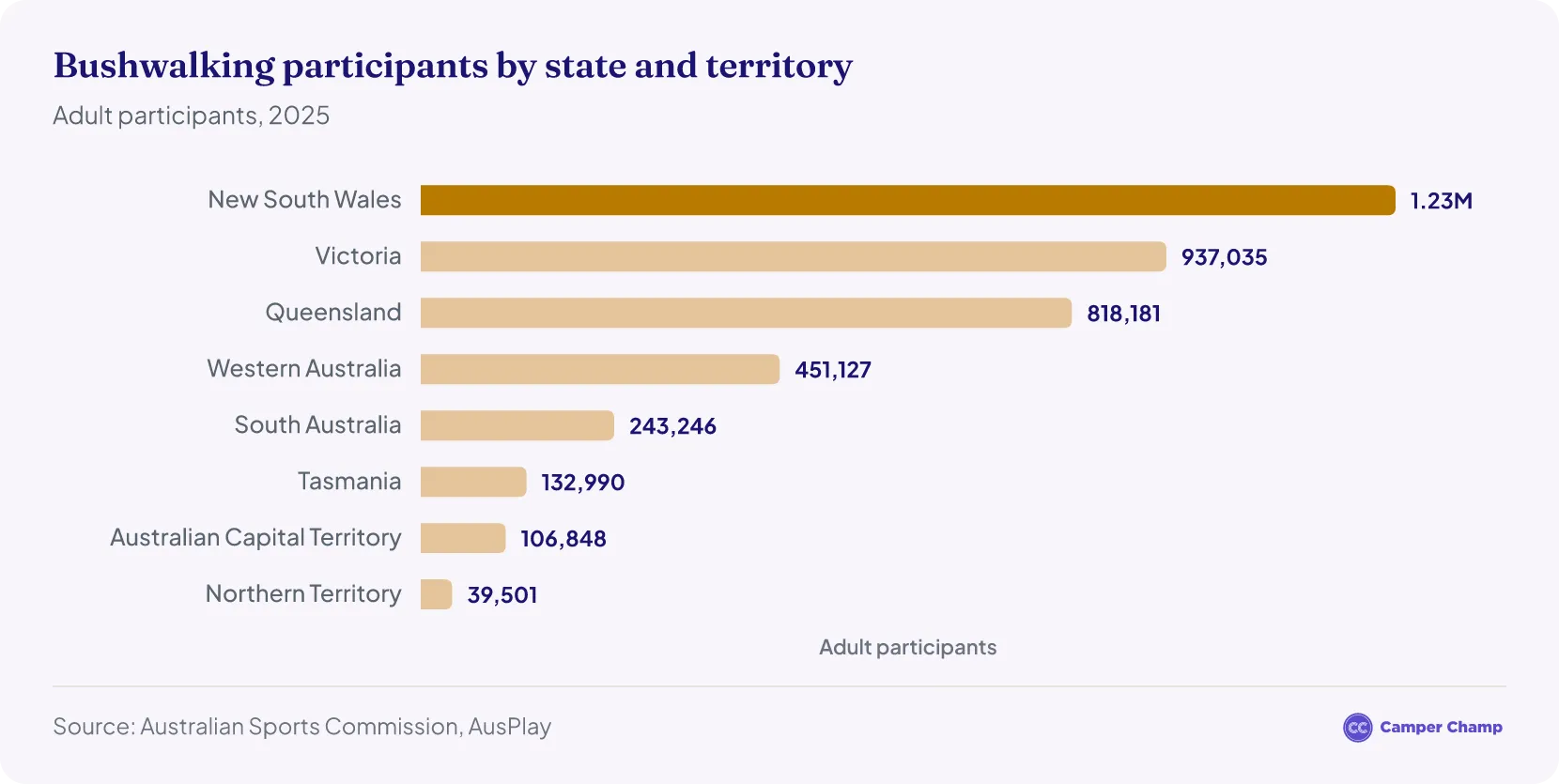
In 2025, New South Wales leads Australia in bushwalking participation, with approximately 1.23 million adults engaging in the activity1, making it the most popular state for hiking and bushwalking.
- Victoria follows with 937,035 participants, while Queensland ranks third with 818,181 bushwalkers.1
- Western Australia recorded 451,127 participants, and South Australia saw 243,246 taking part.1
- Tasmania (132,990), the Australian Capital Territory (106,848), and the Northern Territory (39,501) also took part in bushwalking, reflecting variations in population size and outdoor recreation trends across states.1
Measured as a share of adults, Tasmania has Australia's highest bushwalking participation rate at 27.5%, followed by the ACT at 26.8%, both well above the national rate of 17.5%.1
| State or territory | Adults who hike | Share of adults |
|---|---|---|
| New South Wales | 1,225,023 | 17.4% |
| Victoria | 937,035 | 16.1% |
| Queensland | 818,181 | 17.7% |
| Western Australia | 451,127 | 18.3% |
| South Australia | 243,246 | 15.4% |
| Tasmania | 132,990 | 27.5% |
| Australian Capital Territory | 106,848 | 26.8% |
| Northern Territory | 39,501 | 19.0% |
Hiking Demographics in Australia: Age and Gender
What age group hikes the most in Australia?
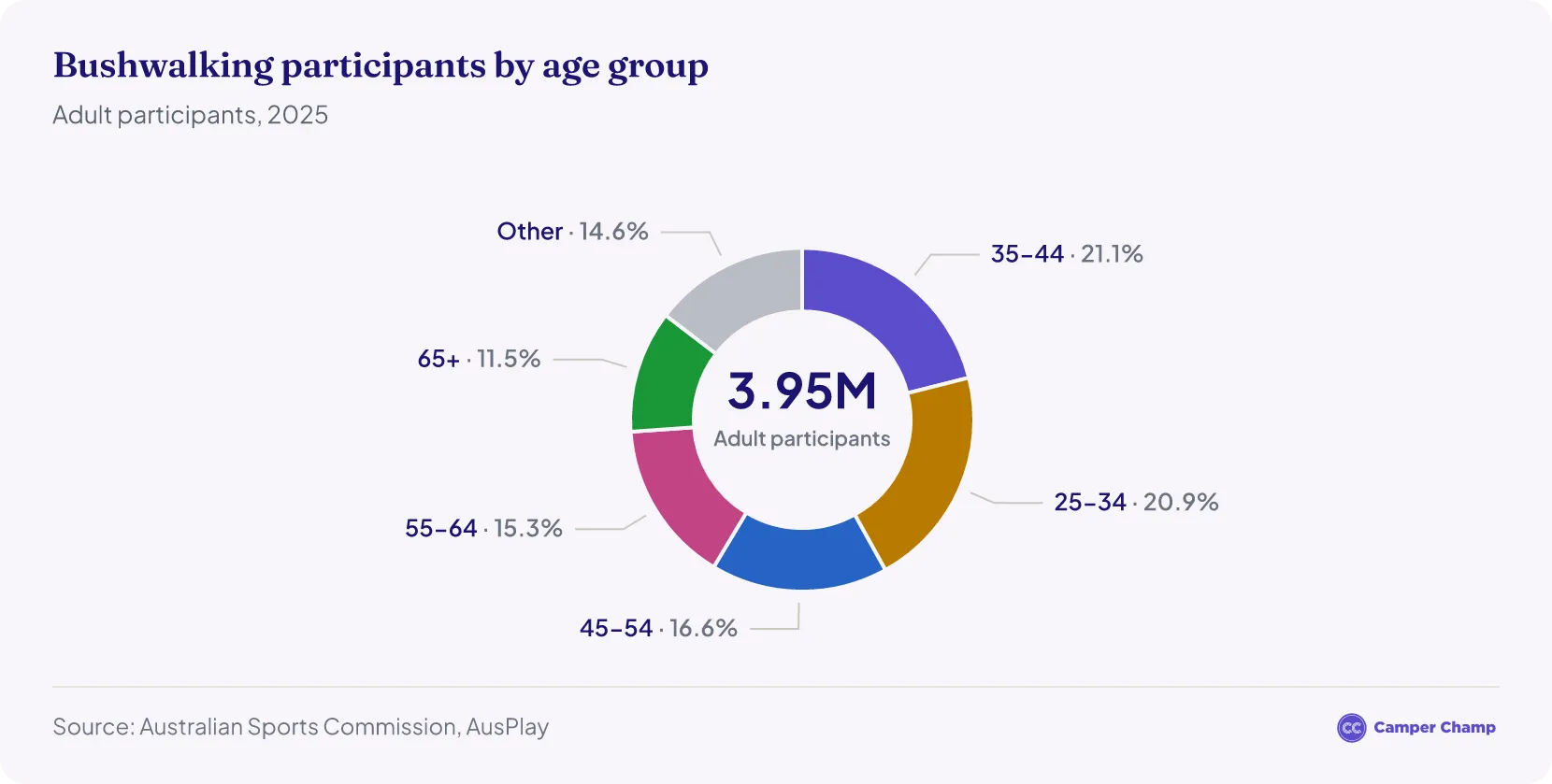
In 2025, ages 35–44 had the most bushwalking/hiking participants, totalling 832,776, just ahead of 25–34 with 826,183 participants.1
Do more women or men go hiking in Australia?
More women than men go hiking in Australia. Female participants make up the majority of people who go bushwalking/hiking, totalling 2.13 million in 2025, which is 17.6% more than male participants.1
- Male participants account for 1.81 million, representing about 46% of total bushwalking participants.1
Hiking Spending in Australia
How much do Australians spend on hiking?
Australian adults spend about $291 million a year on paid bushwalking, such as registration, membership and access fees, according to AusPlay. The figure leaves out equipment, clothing, transport and accommodation, so it is not the total cost of hiking.5
Hiking Motivations in Australia
Why do Australians go hiking?
Nature is the main draw. Among adults thinking about taking up bushwalking, the most common reasons AusPlay recorded were being outdoors or enjoying nature (59%), fun and enjoyment (48%), and physical health or fitness (40%).5
- People who already hike name the same three reasons most often, along with smaller mentions of mental wellbeing and social connection. AusPlay doesn't publish exact percentages for this group.5
Hiking and Camping in Australia
Do people go hiking when they camp?
Yes, many do. Bushwalking or rainforest walks featured in about 5.05 million of the 15.2 million domestic caravan and camping trips Australians took in 2024, roughly one in three. That makes it the second most popular activity on these trips, after eating out.6
- In the latest survey of campers in Western Australia's national and conservation parks, taken over the 2024 school holidays, 72.9% went bushwalking or hiking on their most recent trip, second only to relaxing (90.1%).7
Campervan hire in Australia
- Adelaide campervan rental
- Alice Springs
- Brisbane motorhome hire
- Broome motorhome hire
- Campervan hire in Cairns
- Campervan hire in Launceston
- Campervan hire in Melbourne
- Darwin campervan rental
- Devonport campervan rental
- Gold Coast campervan rental
- Hobart motorhome hire
- Perth motorhome hire
- Sydney motorhome hire
- Tasmania campervan rental
Most Popular Hiking Trails in Australia
What are the most popular hiking trails in Australia?
Bondi to Coogee Coastal Walk, Sydney, NSW was Australia's most popular hike in 2025, based on AllTrails data on which trails Australians walked most.2
- Wineglass Bay and Hazards Beach Circuit, Tas – Ranked second2, this loop crosses the isthmus of Freycinet National Park to two beaches.
- Grand Canyon Track, Blue Mountains, NSW – Ranked third2, a short but steep circuit through a rainforest gorge.
- Cape Byron Walking Track, NSW – Ranked fourth2, a coastal loop past mainland Australia's most easterly point.
- Werribee Gorge Circuit Walk, Vic – Ranked fifth.2
- The rest of the top 10 were Cape Woolamai Circuit (Vic), Mount Ngungun Summit Track (Qld), Twin Falls Circuit (Qld), Lyrebird Loop Track (Vic) and Mount Lofty Loop (SA).2
Australia's Longest Hiking Trails
The Bicentennial National Trail (BNT) stretches 5,330 km3, far longer than the other trails listed here. Its operators call it Australia's premier long-distance trekking route for the self-reliant trekker. It is shared by walkers, horse riders and cyclists; among trails built for walkers alone, the 1,200 km Heysen Trail in South Australia is one of the longest.8
- The trail runs from Cooktown in tropical North Queensland down to Healesville in Victoria3, traversing diverse landscapes and connecting various national parks.
What are the best long-distance hiking trails in Australia?
Heysen Trail (SA) – At 1,200 km8, this is one of Australia's longest walking trails, passing through vineyards, rugged mountains and coastal scenery.
- Bibbulmun Track (WA) – Covering 1,000 km from Kalamunda to Albany9, this trail blends coastal and forest landscapes, with well-equipped campsites along the route for resupply.
- Australian Alps Walking Track (Vic/NSW/ACT) – An approximately 650 km trek10 through Victoria’s High Country, New South Wales and the ACT, offering breathtaking alpine views. This challenging route is best suited for experienced hikers.
- Larapinta Trail (NT) – Spanning 223 km11, this trail runs through the stunning West MacDonnell Ranges, rich in Aboriginal heritage. It typically takes around 12 days to walk end to end.
- Overland Track (Tas) – A 65 km trek12 through Cradle Mountain-Lake St Clair National Park, famous for its alpine scenery. Hikers usually complete it in six days.
Hiking Trends in Australia
What trends are shaping hiking in Australia?
Three trends are shaping hiking in Australia: more people on the trails, booking caps on the busiest multi-day walks and rising climate risk.
- More people hiking: Participation rose from 3.74 million adults in 2024 to 3.95 million in 2025, and the share of adults who hike rose from 16.9% to 17.5%.1
- Booking caps on popular multi-day walks: Tasmania's Overland Track lets a maximum of 34 independent walkers start each day, and adults pay a $312 track fee from 1 October to 31 May.12
- Climate change challenges: Climate change poses significant threats to hiking trails in Australia. A 2024 climate risk index by Zurich and Mandala found that half of Australia's tourism assets, including national parks, already face elevated risk from climate and natural hazards such as bushfires, storms and floods, rising to between 55% and 68% of tourism sites by 2050.13
More Australian Outdoor Statistics
- Glamping Statistics in Australia
- Mountain Biking Statistics in Australia
- Rock Climbing Statistics in Australia
References
- AusPlay results — national, state and by-sport data tables (Australian Sports Commission) · ausport.gov.au ↑ b c d e f g h i j k l m n o p q r s t
- Australia's top-rated hikes of the year revealed (AllTrails 2025) — Australian Traveller · australiantraveller.com ↑ b c d e f g
- Bicentennial National Trail — Australia's premier long distance trekking route · nationaltrail.com.au ↑ b c d
- AusPlay results 2015–2023 (phone survey series) — data tables (Australian Sports Commission) · ausport.gov.au ↑ b c d
- The State of Bushwalking in Australia 2026 — Trail Hiking Australia · trailhiking.com.au ↑ b c d e
- Caravan Industry Association of Australia — Caravan and Camping State of Industry 2025 · assets.pc.gov.au ↑
- The WA camping experience: satisfaction, spending and future intentions (2025) — Parks and Wildlife Service, DBCA Western Australia · library.dbca.wa.gov.au ↑
- Heysen Trail — Friends of the Heysen Trail · heysentrail.asn.au ↑ b c
- The Bibbulmun Track — Bibbulmun Track Foundation · bibbulmuntrack.org.au ↑ b
- Australian Alps Walking Track — Australian Alps National Parks · theaustralianalpsnationalparks.org ↑ b
- Insider guide to hiking the Larapinta Trail — Tourism NT · northernterritory.com ↑ b
- Overland Track — Parks and Wildlife Service Tasmania · parks.tas.gov.au ↑ b c
- Zurich and Mandala release first Climate Risk Index for the Australian tourism sector · zurich.com.au ↑
- AusPlay — Participation Trends in Bushwalking (FY 2015–2024) · clearinghouseforsport.gov.au