

Published
At a glance
- Australia is home to at least 106,000 known animal species.1
- Many live nowhere else on Earth: 87% of its mammals, 93% of its reptiles, 94% of its frogs and 45% of its birds are found only in Australia.1
- Marsupials like kangaroos and koalas share the continent with saltwater crocodiles, a rich variety of birdlife and an abundance of marine life in its coastal waters.
How many animal species are there in Australia?
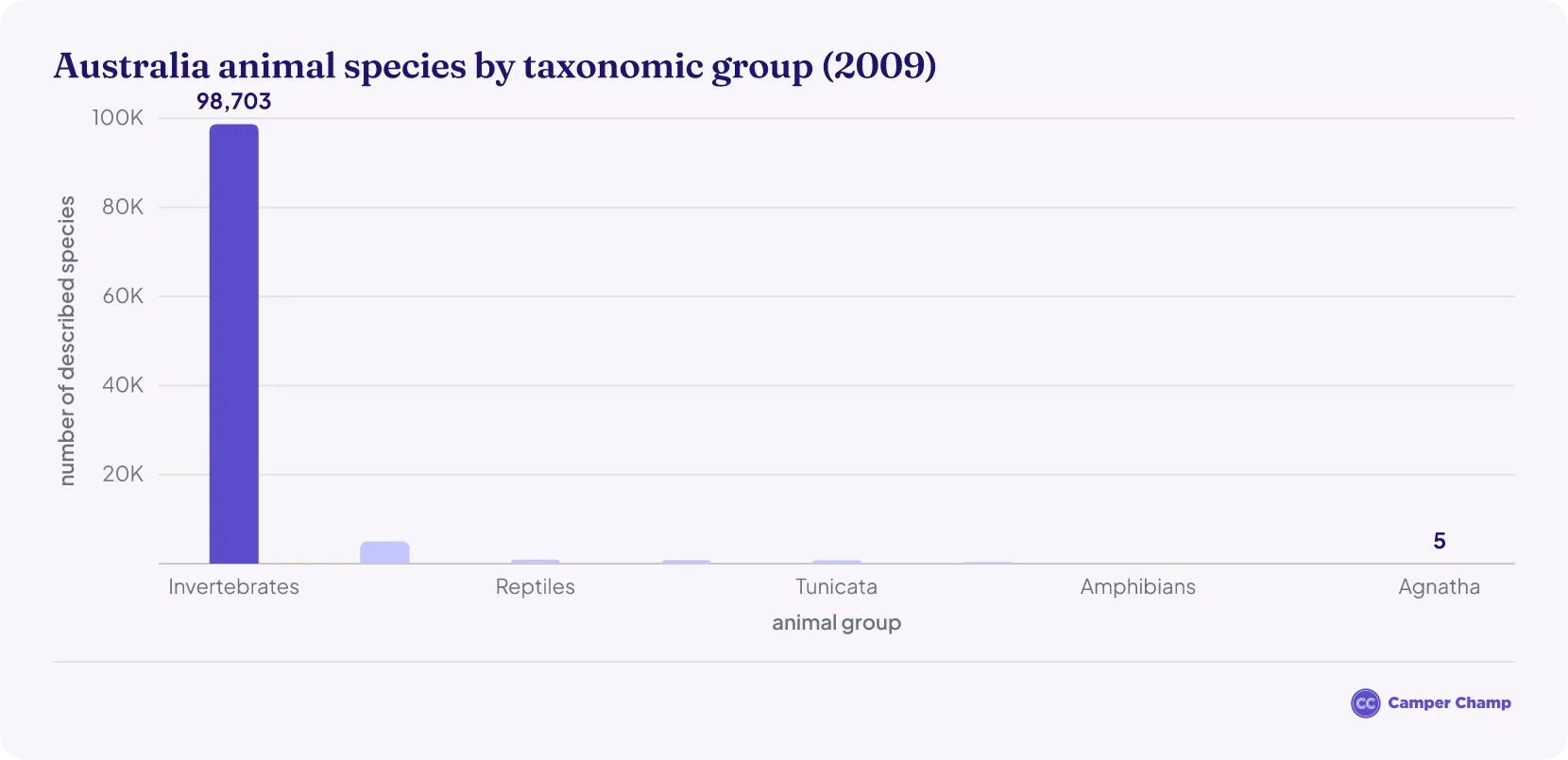
As of 2009, Australia is home to at least 106,000 known animal species across major taxonomic groups.1
- It has 98,703 invertebrate species and 5,000 fish species1; among Australian vertebrates, fish are the most numerous group, thriving in Australia's vast marine and freshwater ecosystems.
- With 917 reptile species, constituting 11.3% of these selected Australian chordate groups1, Australia holds 10.5% of the world's 8,734 known reptile species, including many endemic lizards, snakes, and turtles.
- The 828 bird species (10.2%)1 in Australia include unique and endemic species like the Emu, Kookaburra, and Lyrebird, adapted to diverse habitats.
- Tunicata (757 species, 9.3%)1 are marine filter feeders found in Australia's coral reefs and deep-sea environments.
- Mammals (386 species, 4.7%), amphibians (227 species, 2.8%), cephalochordata (8 species, <0.1%), and agnatha (5 species, <0.1%) also contribute to Australia's wildlife biodiversity.1
The 2009 count is the latest national tally available; no newer edition has been published.
What animals live in Australia?
Australia's best-known animals are the kangaroo, koala, platypus, dingo and wombat. The sections below cover how many of each there are, where they live and what threatens them.
How many kangaroos are there in Australia?
- Australia's kangaroo population numbers in the tens of millions — surveys of the commercial harvest areas in NSW, Queensland, South Australia, Victoria and Western Australia alone counted about 35.3 million in 2023, down from 36.6 million in 20222, and those areas cover only part of the country. That is more kangaroos than people in Australia.
- The Red Kangaroo, the largest species, can stand up to 1.8 metres tall3.
How many koalas are there in Australia?
- The National Koala Monitoring Program (CSIRO) estimates 224,000–524,000 koalas nationally in its 2024 update, with 95,000–238,000 in the threatened northern population across Queensland, NSW and the ACT4.
- Habitat loss, disease and the 2019–2020 bushfires drove the northern population’s formal listing as Endangered in February 20224.
- Koalas live in trees and feed on eucalyptus leaves.
How many platypuses are there in Australia?
The platypus, a rare egg-laying mammal, lives in freshwater rivers and lakes across eastern Australia and is still considered widespread.
There is no reliable national platypus count, but UNSW's national assessment found the area occupied by platypuses shrank about 23% over the three decades to 20205, driven by drought, water pollution and habitat fragmentation.
- Declines are steepest near urban areas and in the Murray–Darling Basin. Conservation programs, including platypus eDNA monitoring, are working to reverse the trend.
How many dingoes are there in Australia?
The dingo, Australia's wild dog, is known for its adaptability and hunting prowess.
There is no reliable national count of Australia's dingo population — estimates vary widely, and numbers are shaped by ongoing culling and land management.
- Hybridisation with domestic dogs threatens the genetic purity of the species.
How many wombats are there in Australia?
Wombats are burrowing marsupials that can weigh up to 40 kg6.
Common Wombats remain widespread across south-eastern Australia, though no reliable national count exists.
- Southern Hairy-nosed Wombat populations fluctuate with drought cycles across their fragmented range.
- Northern Hairy-nosed Wombats are one of Australia's great conservation successes: from only 35 individuals in the 1980s to about 400 at the most recent census in 20227, protected within a predator-fenced reserve.
How many animals are endangered or extinct in Australia?
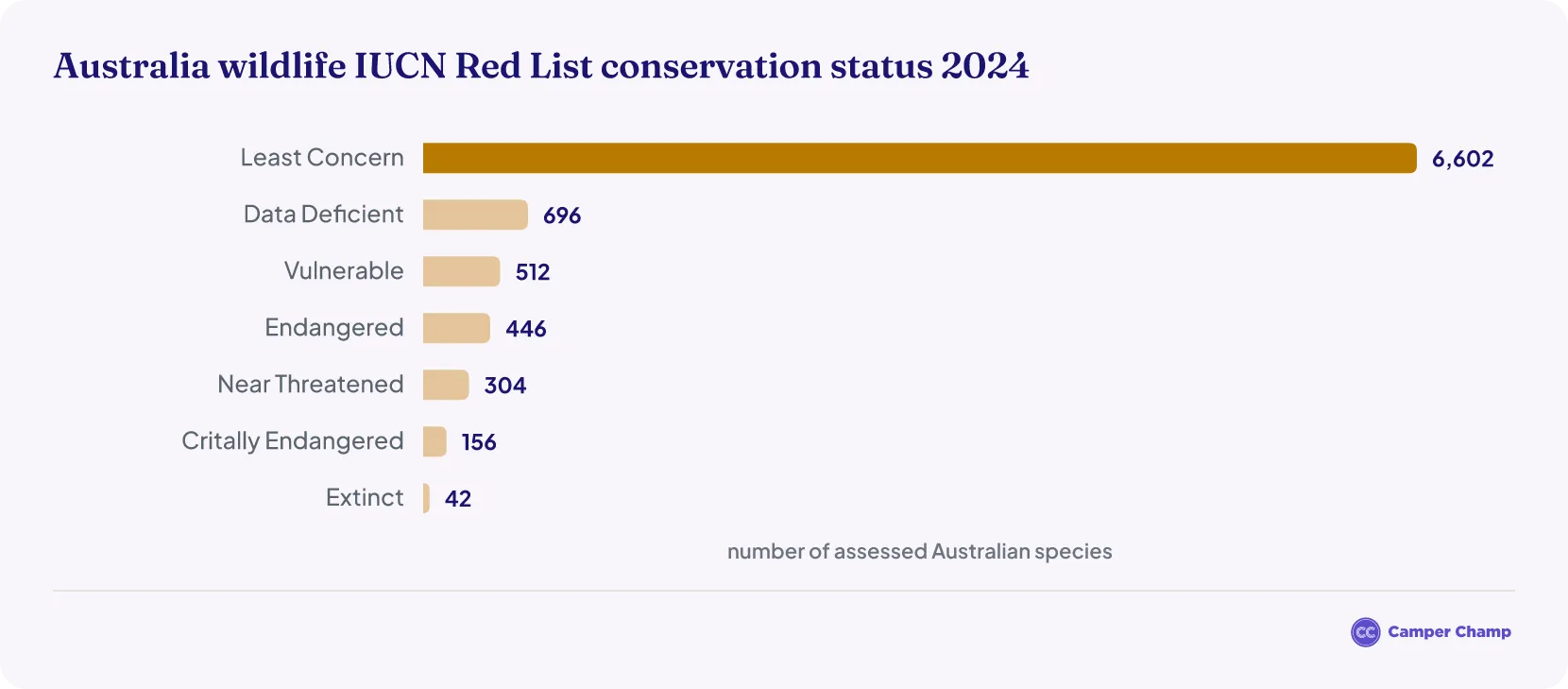
619 animals are listed as threatened under Australia's national environment law (the EPBC Act): 147 critically endangered, 250 endangered and 222 vulnerable. Another 67 are listed as extinct and one fish as extinct in the wild.8
How many wildlife deaths have occurred in Australia?
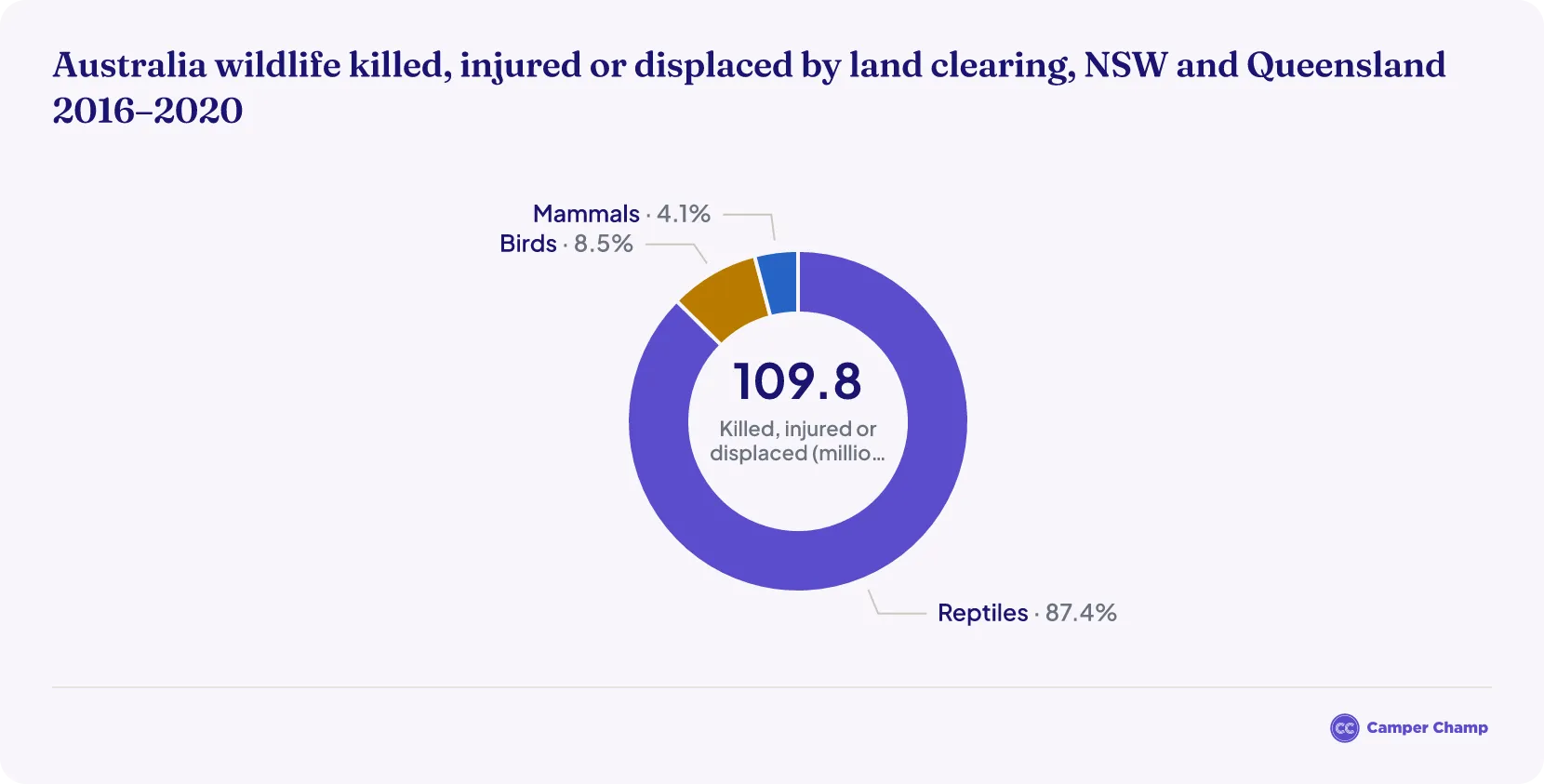
Over 100 million animals in Australia were killed, injured, or displaced due to habitat destruction in NSW and Queensland from 2016 to 2020.9 Based on available data provided by Greenpeace Australia Pacific and RSPCA Queensland, the estimated number of animals killed, injured or displaced in NSW and Queensland over that period includes:
Reptiles suffer the most, as 2.4 million hectares of forest and bushland have been cleared, with 90% of bushland loss in NSW and Queensland linked to beef production.9
How many animals died in the Black Summer bushfires?
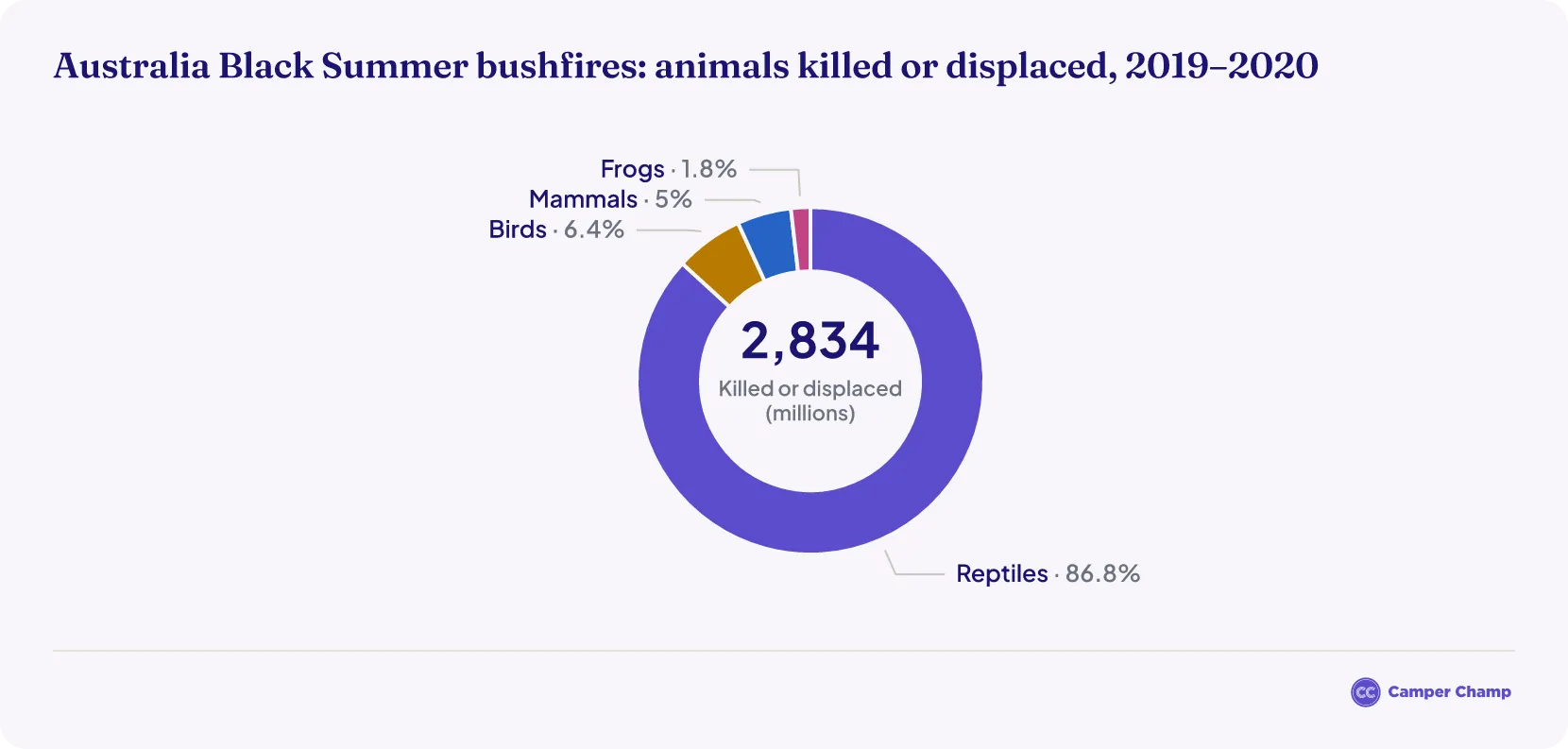
The 2019–2020 Black Summer bushfires in Australia were among the most devastating in history, burning up to 19 million hectares10 and leaving nearly 3 billion animals killed or displaced, including:
- Reptiles: 2.46 billion10
- Birds: 0.18 billion (180 million)10
- Mammals: 0.143 billion (143 million)10
- Frogs: 0.051 billion (51 million)10
Reptiles suffered the highest losses due to their reliance on fire-prone habitats and limited ability to escape rapidly spreading fires.
How many feral animals are there in Australia?
Introduced predators and pests are one of the biggest threats to Australia's wildlife. Feral cats kill over 1.5 billion native mammals, birds, reptiles and frogs each year11. An estimated 2.1 million feral cats live in the bush, a number that swings between 1.4 million in dry years and 5.6 million after widespread rain12. At least 34 mammal species have gone extinct in Australia since European settlement, and cats were a primary contributor to over two-thirds of them.
- Foxes: an estimated 7.2 million in 200413.
- Feral pigs: an estimated 13.5 million, from a 1990 estimate14.
- Feral camels: about one million in 200815.
- Cane toads: spreading west at an estimated 40 to 60 km a year16.
Invasive species cost Australia around A$24.5 billion a year17.
Best places to see wildlife in Australia
In terms of National Parks, Daintree Rainforest, Queensland is the most biodiverse: it lies within the Wet Tropics World Heritage Area, home to 368 bird species and 107 mammal species18, plus numerous reptiles and amphibians.
- Marine Reserves: Great Barrier Reef, Queensland hosts 1,500+ fish species, 400 corals19, and various marine mammals, making it the richest ecosystem.
- Remote Areas: Kangaroo Island, South Australia has 25 land mammal species (eight of them introduced)20 and numerous birds.
National Park
Kakadu National Park, Northern Territory
- Total Species: Over 280 bird species21, 77 mammal species, 132 reptile species, and over 10,000 insect species22.
Uluru-Kata Tjuta National Park, Northern Territory
Daintree Rainforest, Queensland
- Total Species: 368 bird species and 107 mammal species across the wider Wet Tropics World Heritage Area18, plus numerous reptiles and amphibians.
Great Otway National Park, Victoria
- Total Species: 139 mammal species recorded across the Great Otway parks and reserves25, and numerous bird species.
Wilsons Promontory National Park, Victoria
Marine Reserve
Great Barrier Reef, Queensland
- Total Species: Over 1,500 fish species, 400 coral species19, and marine life such as dolphins and turtles.
Ningaloo Marine Park, Western Australia
- Total Species: More than 500 fish species28 and other marine life, including whale sharks.
Shoalwater Islands Marine Park, Western Australia
- Total Species: At least 75 fish species recorded in its shallow nearshore waters29, and various seabirds.
Remote Areas
Kangaroo Island, South Australia
- Total Species: 25 land mammal species (eight of them introduced) and numerous bird species20.
Cradle Mountain, Tasmania
- Total Species: Tasmanian devils, spotted-tailed and eastern quolls, wombats, platypus and echidnas30.
Cape Nelson Lighthouse Reserve, Victoria
- Total Species: Various marine mammals including whales during migration seasons31.
Where can you see wildlife on a camping or caravan trip?
Some of Australia's best wildlife parks have campgrounds you can drive a campervan or caravan straight into, so you wake up where the animals are.
- Wilsons Promontory, Victoria: Tidal River Campground has 484 camping and caravan sites32, and the Prom's day walks are a good chance to see kangaroos, wallabies, emus and wombats. Parks Victoria asks drivers to avoid the road in between dusk and dawn, when wildlife is about.
- Kakadu National Park, Northern Territory: several campgrounds can take caravans, including Cooinda, Merl and Gunlom33.
- Cape Range National Park, Western Australia: on the Ningaloo coast, campgrounds such as Kurrajong are a 150 m walk from the beach34, in a park home to kangaroos, emus, echidnas and black-flanked rock wallabies.
Campervan hire in Australia
When is the best time to see wildlife in Australia?
Most native animals come out to feed at dawn and dusk, which makes these the best times to look for them and the worst times to be driving35. For the big seasonal sights, plan around these windows:
- Whale sharks at Ningaloo, WA: March to August36.
- Humpback whales: off NSW heading north from May to July and returning south from September to November37; at Ningaloo from June to November36.
- Southern right whales: at the Head of Bight in SA from mid-May to late October, peaking in July and August38; calving at Warrnambool's Logans Beach from June to September39.
- Turtles at Mon Repos, Qld: nesting from November to early February, hatchlings from late January to the end of March40.
- Wildflowers in WA: from the Pilbara in June to Margaret River in October41.
How many zoos and wildlife sanctuaries are there in Australia?
At the turn of the century, Australia had over 200 captive wildlife facilities, which drew more than 8 million visitors a year, about five million (62.5%) of them Australian42, according to Australian Bureau of Statistics figures from the late 1990s. By 2020, zoos and aquariums were counting over 20 million visits a year43, and Australians' visits to wildlife parks, zoos and aquariums grew 46% from 2014 to 202344. These facilities include:
- Large, publicly owned or statutory zoos, which exhibit both native and exotic animals.
- Wildlife exhibits within major theme parks, offering close encounters with various species.
- Privately owned zoos and fauna parks, which operate independently without subsidies and primarily feature Australian native wildlife.
- Small native wildlife exhibits integrated into broader tourist attractions with diverse themes.
- Independent wildlife exhibitors, who maintain small captive collections for public display.
How many people are killed by wildlife in Australia?
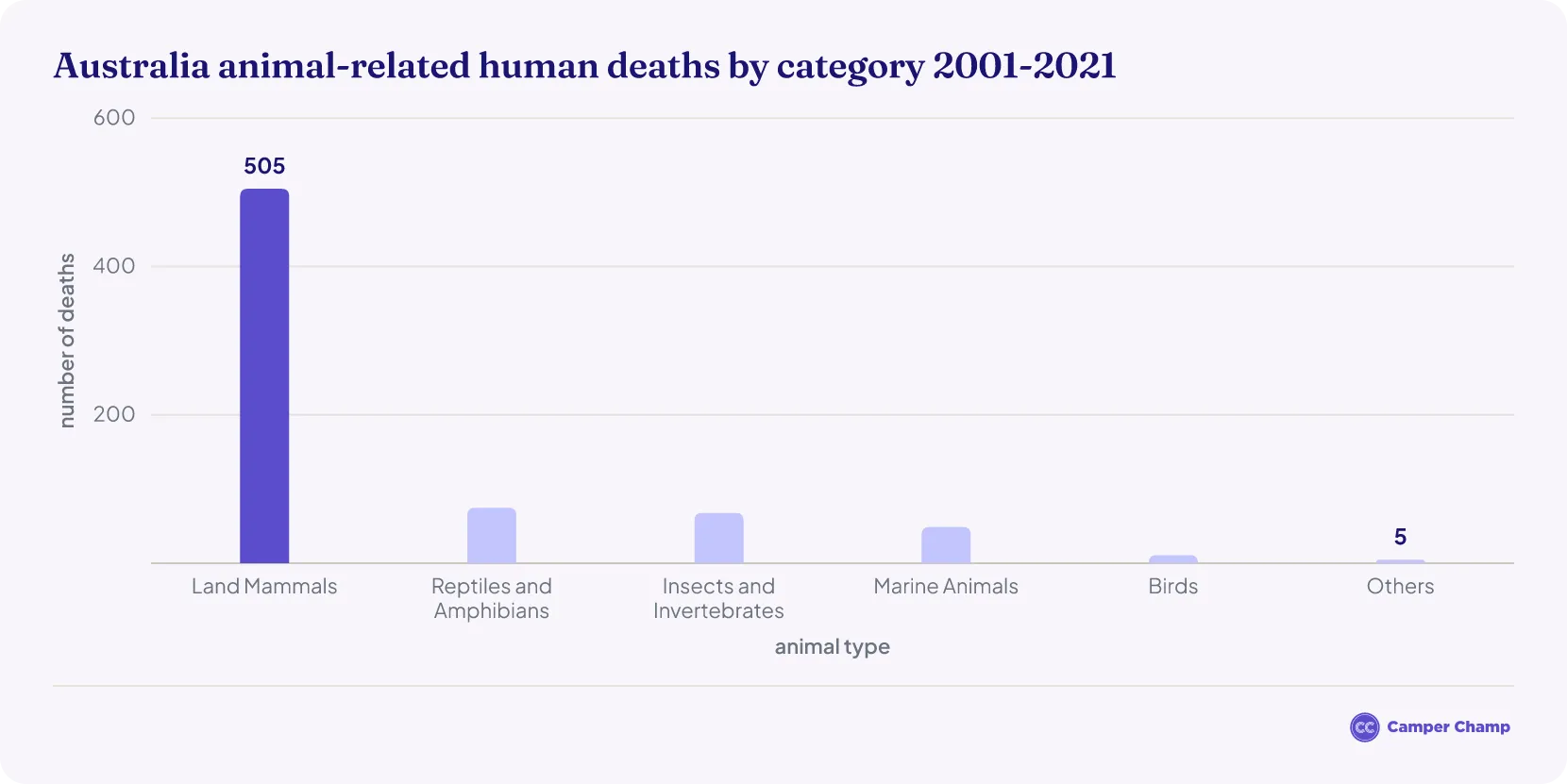
Where do most animal-related incidents occur?
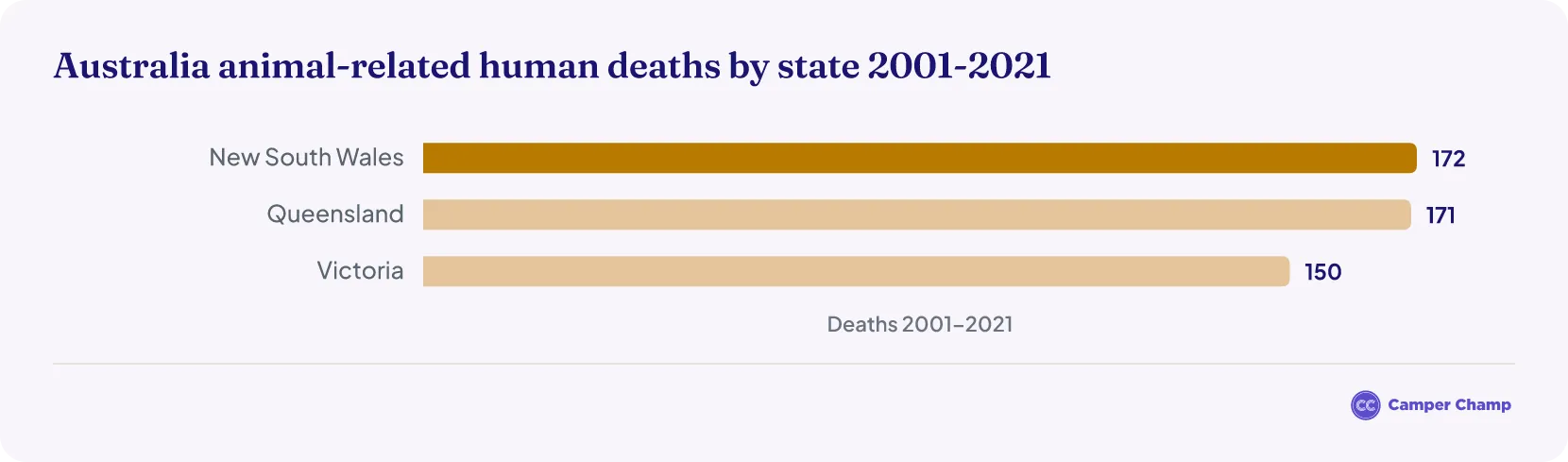
Most animal-related incidents occurring from 2001 to 2021 are in New South Wales (24.1%), Queensland (24.0%), and Victoria (21.0%), accounting for a combined total of 69.1% of all fatal animal-related incidents in Australia.45
How many wildlife collisions happen on Australian roads?
Hitting an animal is one of the biggest risks on an Australian road trip. NRMA Insurance received more than 15,000 animal collision claims in 2025, 21% more than in 202446, and kangaroos accounted for 84% of its wildlife-related claims.
- Worst months: the risk rises between April and September, and July had the most claims nationally in 202547.
- Worst times: dawn, dusk and night, when you're most likely to meet kangaroos on the road48.
- Victoria: RACV received 7,232 kangaroo collision claims in 2025, an average of 20 a day, and the average claim cost $9,00048.
- Hotspot: Dubbo in the Central West is NSW's top suburb for wildlife collisions46.
- Country roads: in NSW, 1 in every 41 crashes on country roads resulting in injury or death involves a vehicle hitting an animal49.
Each insurer counts only its own customers' claims, so the national total is higher than any one insurer's figure.
Other Resources
- Blue Mountains Tourism Statistics
- Freycinet National Park Tourism Statistics
- Kakadu National Park Tourism Statistics
- National Park Statistics in Australia
- Three Sisters Tourism Statistics
- Uluru-Kata Tjuta National Park Tourism Statistics
What are the deadliest animals in Australia?
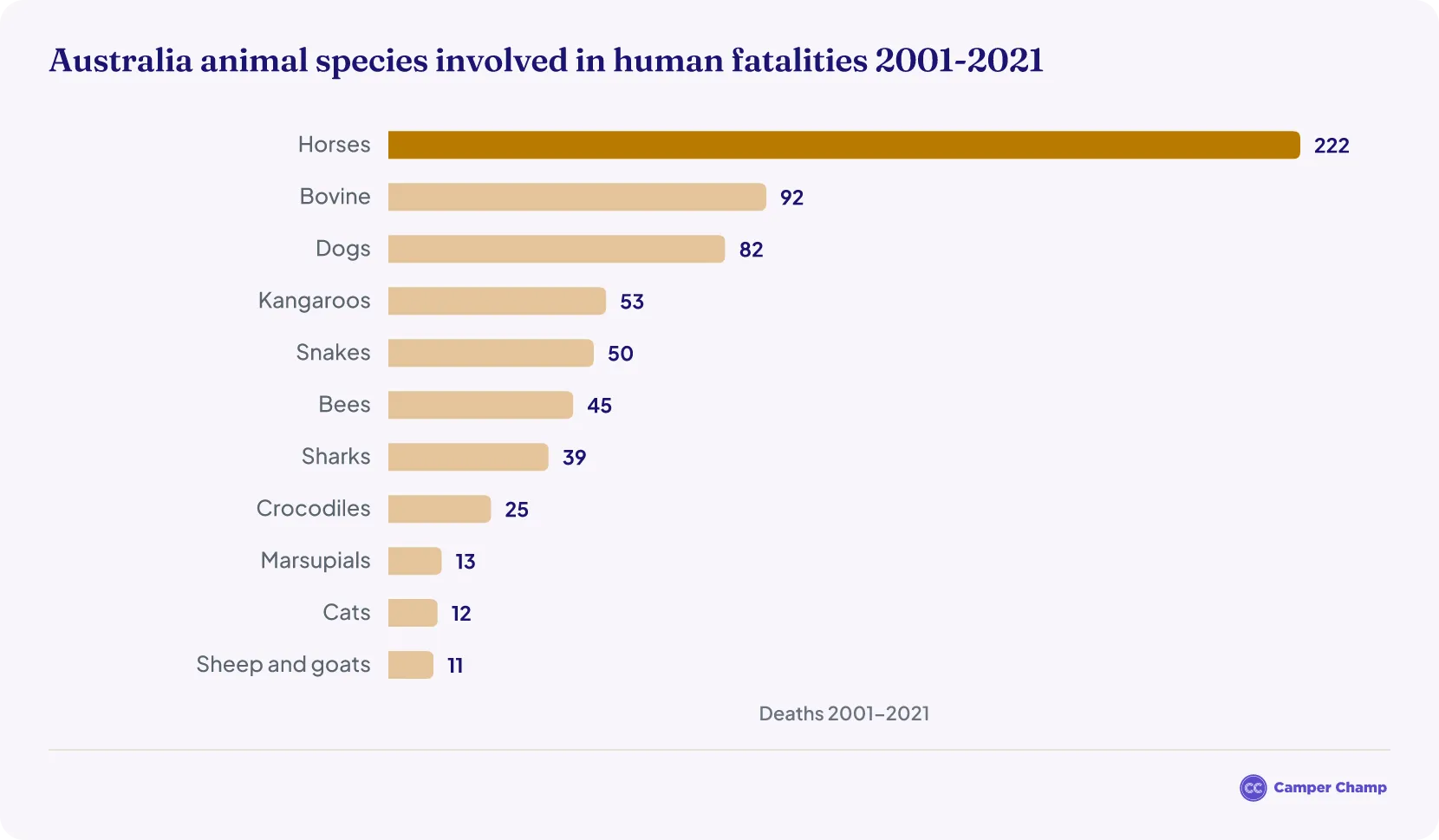
Horses are the deadliest animals in Australia, involved in 222 deaths reported to a coroner from 2001 to 2021, more than snakes, sharks and crocodiles combined.45 They are followed by cattle (92 deaths) and dogs (82 deaths).
- Followed by kangaroos (53 deaths), snakes (50 deaths), and bees (45 deaths); and smaller numbers from sharks (39 deaths), crocodiles (25 deaths)45, as well as other marsupials (13 deaths), cats (12 deaths), and sheep/goats (11 deaths).
References
- Numbers of Living Species in Australia and the World (2nd edn, Chapman 2009, ABRS) · dcceew.gov.au ↑ b c d e f g h
- Kangaroo population, quota and harvest statistics by state — DCCEEW · dcceew.gov.au ↑
- Macropus rufus (red kangaroo) — Animal Diversity Web · animaldiversity.org ↑
- 2024 update of National Koala Population estimates (NKMP, CSIRO) · nkmp.org.au ↑ b
- Platypus Conservation Initiative — Distribution and numbers (UNSW) · unsw.edu.au ↑
- Lasiorhinus krefftii — Northern Hairy-nosed Wombat, Species Profile and Threats Database · environment.gov.au ↑
- Northern hairy-nosed wombat — featured project (Queensland Government) · qld.gov.au ↑
- EPBC Act List of Threatened Fauna (DCCEEW, SPRAT) · environment.gov.au ↑
- 100 Million Animals Killed: Number of Animals Killed Each Year · greenpeace.org.au ↑ b c d e
- Australia’s 2019-2020 Bushfires: The Wildlife Toll · assets.wwf.org.au ↑ b c d e
- Feral cats — DCCEEW · dcceew.gov.au ↑
- The impact of cats in Australia — NESP Threatened Species Recovery Hub, 2020 · nespthreatenedspecies.edu.au ↑
- Background document for the Threat Abatement Plan for predation by the European red fox — DEWHA, 2008 · dcceew.gov.au ↑
- Australian Feral Pig Report — National Feral Pig Action Plan, July 2020 · feralpigs.com.au ↑
- National Feral Camel Action Plan — Commonwealth of Australia, 2010 · dcceew.gov.au ↑
- The cane toad (Bufo marinus) fact sheet — DCCEEW · dcceew.gov.au ↑
- Pest plants and animals cost Australia around $25 billion a year — CSIRO, 2 August 2021 · csiro.au ↑
- Wet Tropics of Queensland — UNESCO World Heritage Centre · whc.unesco.org ↑ b
- Great Barrier Reef — UNESCO World Heritage Centre · whc.unesco.org ↑ b
- A Biological Survey of Kangaroo Island, South Australia · data.environment.sa.gov.au ↑ b
- Birds — Kakadu National Park, Parks Australia · kakadu.gov.au ↑
- World Heritage Places — Kakadu National Park, DCCEEW · dcceew.gov.au ↑
- Uluru-Kata Tjuta National Park Management Plan 2010–2020 · dcceew.gov.au ↑
- Plants and animals — Uluru-Kata Tjuta National Park, DCCEEW · dcceew.gov.au ↑
- Conservation Action Plan: Great Otway parks and reserves — Parks Victoria · parks.vic.gov.au ↑
- Wilsons Promontory National Park Management Plan — Parks Victoria · parks.vic.gov.au ↑
- Wilsons Promontory National Park — Parks Victoria · parks.vic.gov.au ↑
- Ningaloo Coast World Heritage Area — DBCA · dbca.wa.gov.au ↑
- Shoalwater Islands Marine Park Management Plan 2007–2017 · dbca.wa.gov.au ↑
- Cradle Mountain — Tasmania Parks and Wildlife Service · parks.tas.gov.au ↑
- Cape Nelson State Park — Parks Victoria · parks.vic.gov.au ↑
- Tidal River Campground — Wilsons Promontory National Park, Parks Victoria · parks.vic.gov.au ↑
- Caravans — Kakadu National Park, Parks Australia · kakadu.gov.au ↑
- Cape Range National Park — Explore Parks WA (DBCA) · exploreparks.dbca.wa.gov.au ↑
- A guide to spotting wildlife in NSW national parks — NSW National Parks · nationalparks.nsw.gov.au ↑
- Ningaloo Marine Park — Explore Parks WA (DBCA) · exploreparks.dbca.wa.gov.au ↑ b
- Humpback whale — NSW National Parks · nationalparks.nsw.gov.au ↑
- Nullarbor National Park — National Parks and Wildlife Service South Australia · parks.sa.gov.au ↑
- Logans Beach — Visit Great Ocean Road · visitgreatoceanroad.org.au ↑
- Mon Repos Turtle Encounter tours — Queensland Parks · parks.qld.gov.au ↑
- Find wildflowers — Tourism Western Australia · westernaustralia.com ↑
- Captive Wildlife: Number of Australia’s Zoos and Wildlife Facilities · sustain.pata.org ↑
- Funding lifeline for Australia's zoos and aquariums — media release, 28 April 2020 · trademinister.gov.au ↑
- The rise of nature-based tourism in Australia — Austrade · austrade.gov.au ↑
- NCIS Fact Sheet FS24-09 — Animal-related deaths in Australia, 2001–2021 · files.ncis.org.au ↑ b c d e
- Wildlife collision hotspots in Australia — NRMA Insurance · nrma.com.au ↑ b
- 15,000 animal collisions in a year: NRMA Insurance warns drivers — IAG, 30 March 2026 · iag.com.au ↑
- How to avoid kangaroo collisions in Victoria — RACV, 27 August 2026 · racv.com.au ↑ b
- Watch for animals — Transport for NSW · transport.nsw.gov.au ↑
- IUCN Red List — Summary Statistics · iucnredlist.org
- Numbers of Living Species in Australia and the World · dcceew.gov.au