

Updated
At a glance
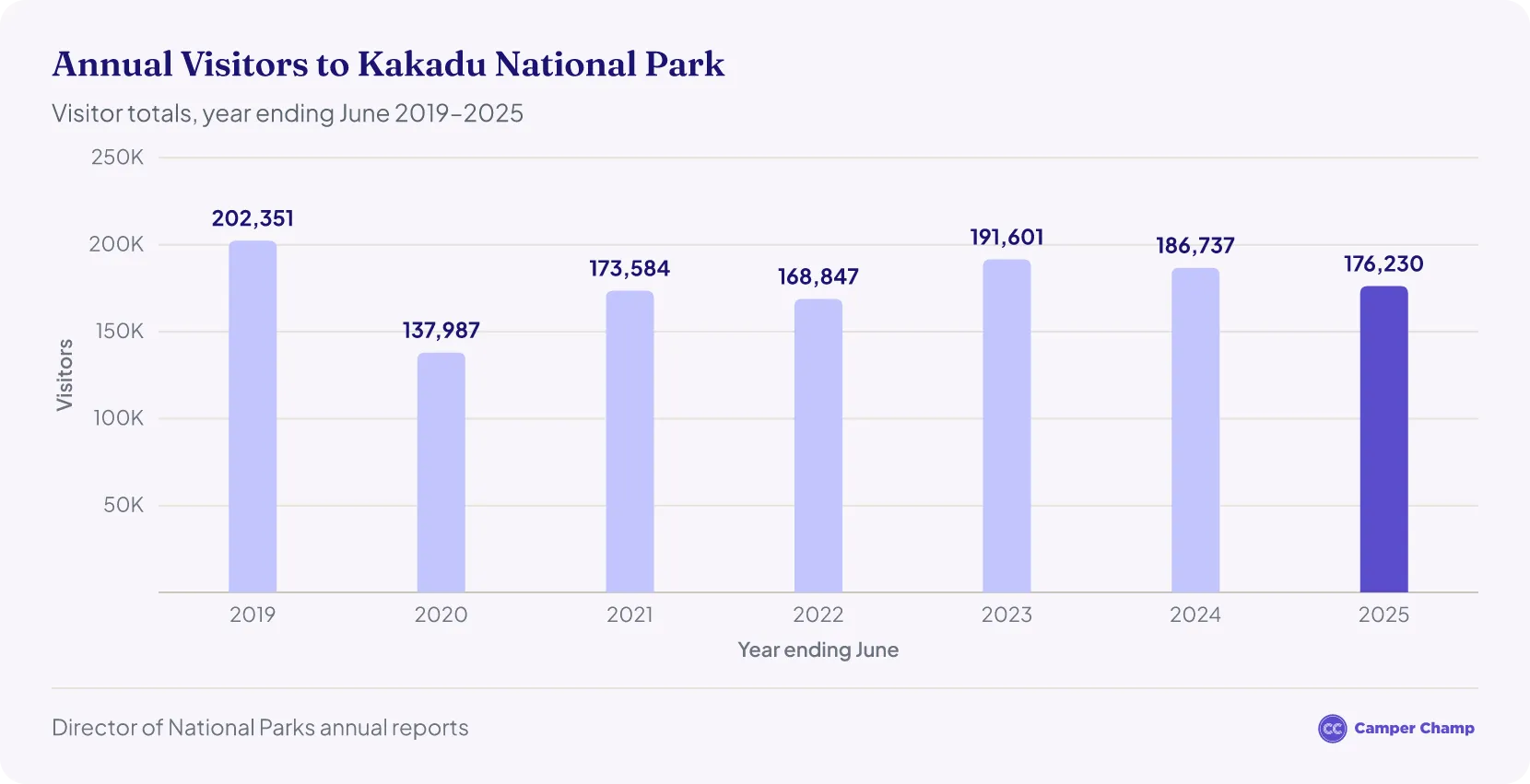
- 176,230 people visited Kakadu National Park in the year ending June 2025, down 5.6% on the year before.1
- On average, around 500 visitors a day, depending on the season.1
- Peak season is the dry season, from May to October.2
- One of Australia's largest national parks (20,000 square kilometres)3 and a UNESCO World Heritage Site4.
How many people visit Kakadu National Park each year?
Kakadu National Park typically draws between 160,000 and 200,000 visitors a year1.
Kakadu National Park economic impact and visitor spending
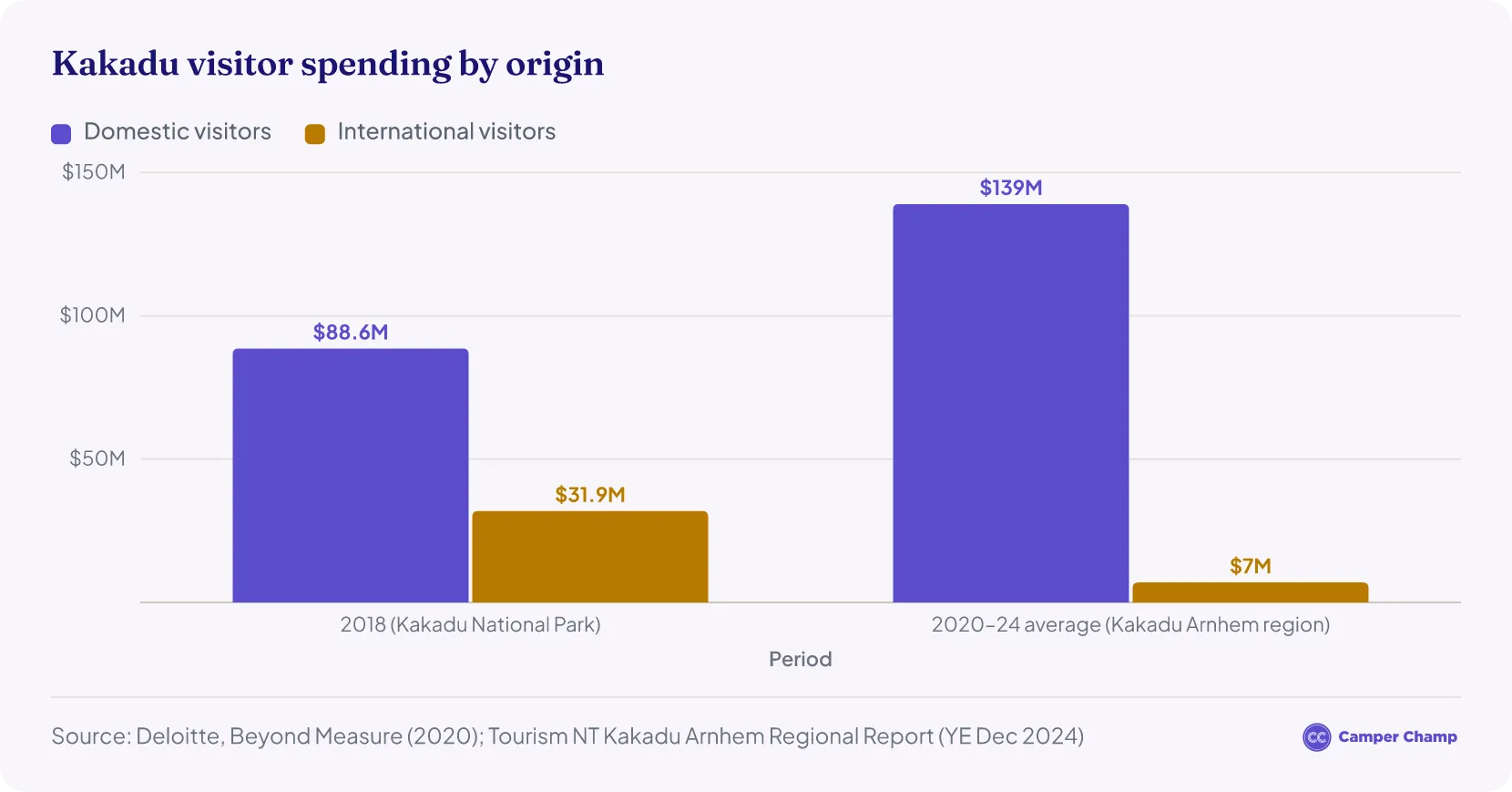
Kakadu National Park contributed $136 million to the Australian economy and supported 1,188 jobs in 2018, according to a Deloitte study for the Northern Territory Government6. Most of those jobs came from tourism in the park.
- Domestic visitors spent $88.6 million in the region in 2018, and international visitors $31.9 million.6
- The same study valued Kakadu as a social asset worth $10 billion.6
- Overnight visitors to the wider Kakadu Arnhem tourism region spent an average of $146 million a year over 2020–24, or $862 per trip.7
How much does it cost to visit Kakadu National Park?
An adult park pass for Kakadu National Park costs $25 to $40, depending on the season: $40 in the dry season (15 May – 31 October) and $25 in the tropical summer (1 November – 14 May)8. Each pass is valid for seven days.
- Children aged 5–15 pay $20 in the dry season or $12.50 in the tropical summer.8
- Free for Northern Territory residents.8
When is the peak season in Kakadu National Park?
The dry season, from May to October, is the most popular time to visit.2
- May – The early dry season, when visitors start arriving ahead of the crowds.
- June – Cooler, drier days settle in and visitor numbers build through the month.
- July – The height of the dry season and the best time for waterfalls and Aboriginal rock art sites.
- August – Much like July, with warm weather and clear skies.
- September – The dry season winds down and wildlife viewing is excellent.
- October – The last month of the dry season, with hotter, more humid days as the tropical summer approaches.
How popular is Kakadu National Park?
Kakadu isn’t one of Australia’s most visited parks, largely because it’s so remote, but it is one of the best known.
- Kakadu is one of the largest national parks in Australia9 (20,000 square kilometres)3. It is listed as a UNESCO World Heritage Site4.
Why do people visit Kakadu National Park?
Kakadu offers an extraordinary mix of wildlife, Aboriginal culture and landscapes. Highlights include:
- Jim Jim Falls & Twin Falls – best seen in the dry season.
- Ubirr & Nourlangie Rock Art Sites – Aboriginal rock art painted over thousands of years.
- Yellow Water Billabong – crocodiles and birdlife.
- Maguk (Barramundi Gorge) – pristine waterfall and swimming hole.
- Gunlom Falls – a natural infinity pool with sweeping views.
Camping Options at Kakadu National Park
Camping is a popular way to stay in Kakadu National Park, though it isn’t the only option:
- Caravan parks – sites with full facilities
- Bush camping – remote, unpowered sites
- Lodge-style accommodation – more comfortable, higher-end stays inside the park.
Campervan hire in Australia
Facts About Kakadu National Park
Things to do at Kakadu National Park
- See ancient Aboriginal rock art at Ubirr and Nourlangie, some of the world’s oldest and most important rock paintings, which tell stories of Dreamtime ancestors and traditional life.
- Take a guided Yellow Water Billabong cruise to see saltwater crocodiles, wild horses and birdlife – best at sunrise or sunset.
- Hike to Maguk, Gunlom Falls or along the Barrk Sandstone Walk for escarpment views, clear plunge pools and monsoon forest.
- Join a cultural tour or visit the Warradjan Aboriginal Cultural Centre to learn about the lives, traditions and spiritual beliefs of the Bininj/Mungguy people, who have lived in Kakadu for more than 65,000 years3.
- Explore the park by 4WD, especially in the dry season, when the tracks open to places like Jim Jim Falls and Twin Falls.
Safety Tips While Visiting Kakadu National Park
- Drink plenty of water to avoid dehydration.
- Stay alert around wildlife.
- Don’t swim in rivers – crocodiles live in them.
- Stick to marked trails.
- Check park conditions before you go, as some sites close, especially in the wet season.
- Carry insect repellent.
Kakadu National Park visitor FAQs (2025)
How many people visited Kakadu National Park in 2025?
176,230 people visited Kakadu National Park in the year ending June 2025.1
How many people visit Kakadu National Park per day?
Kakadu National Park gets about 500 visitors a day on average, though the number varies with the season.1
How far is Kakadu National Park from Darwin?
The drive from Darwin takes about three hours, via the Stuart Highway and then the Arnhem Highway.12 There are no commercial flights to Kakadu, so most visitors fly into Darwin and hire a vehicle or join a tour.
Do you need a 4WD to visit Kakadu National Park?
Not for many of the popular sites – a normal 2WD will get you there13. Twin Falls, Jim Jim Falls, Maguk, Jarrangbarnmi and West Alligator Head can only be reached by 4WD.
Other Resources
- Blue Mountains Tourism Statistics
- Freycinet National Park Tourism Statistics
- National Park Statistics in Australia
- Three Sisters Tourism Statistics
- Uluru-Kata Tjuta National Park Tourism Statistics
- Wildlife Statistics in Australia
References
- Director of National Parks Annual Report 2024–25 · dcceew.gov.au ↑ b c d e f g h
- When to come – Kakadu National Park, Parks Australia · kakadu.gov.au ↑ b
- Amazing facts – Kakadu National Park, Parks Australia · kakadu.gov.au ↑ b c d
- World Heritage Places — Kakadu National Park, DCCEEW · dcceew.gov.au ↑ b c
- Tourism Key Figures and Statistics · dcceew.gov.au ↑ b
- Beyond Measure: The economic and social value of Kakadu National Park (Deloitte for NT Department of the Chief Minister, 2020) · cmc.nt.gov.au ↑ b c
- Kakadu Arnhem Regional Report, year ending December 2024 (Tourism NT) · tourismandeventsnt.com.au ↑
- Park passes – Kakadu National Park · kakadu.gov.au ↑ b c
- Itineraries – Kakadu National Park, Parks Australia · kakadu.gov.au ↑ b c d
- Plants – Kakadu National Park, Parks Australia · kakadu.gov.au ↑
- Birds — Kakadu National Park, Parks Australia · kakadu.gov.au ↑
- Getting here – Kakadu National Park, Parks Australia · kakadu.gov.au ↑
- Getting around – Kakadu National Park, Parks Australia · kakadu.gov.au ↑ b c
- Parks Australia Annual Report · dcceew.gov.au