

Published
How Common Are Crocodile Attacks in Australia?
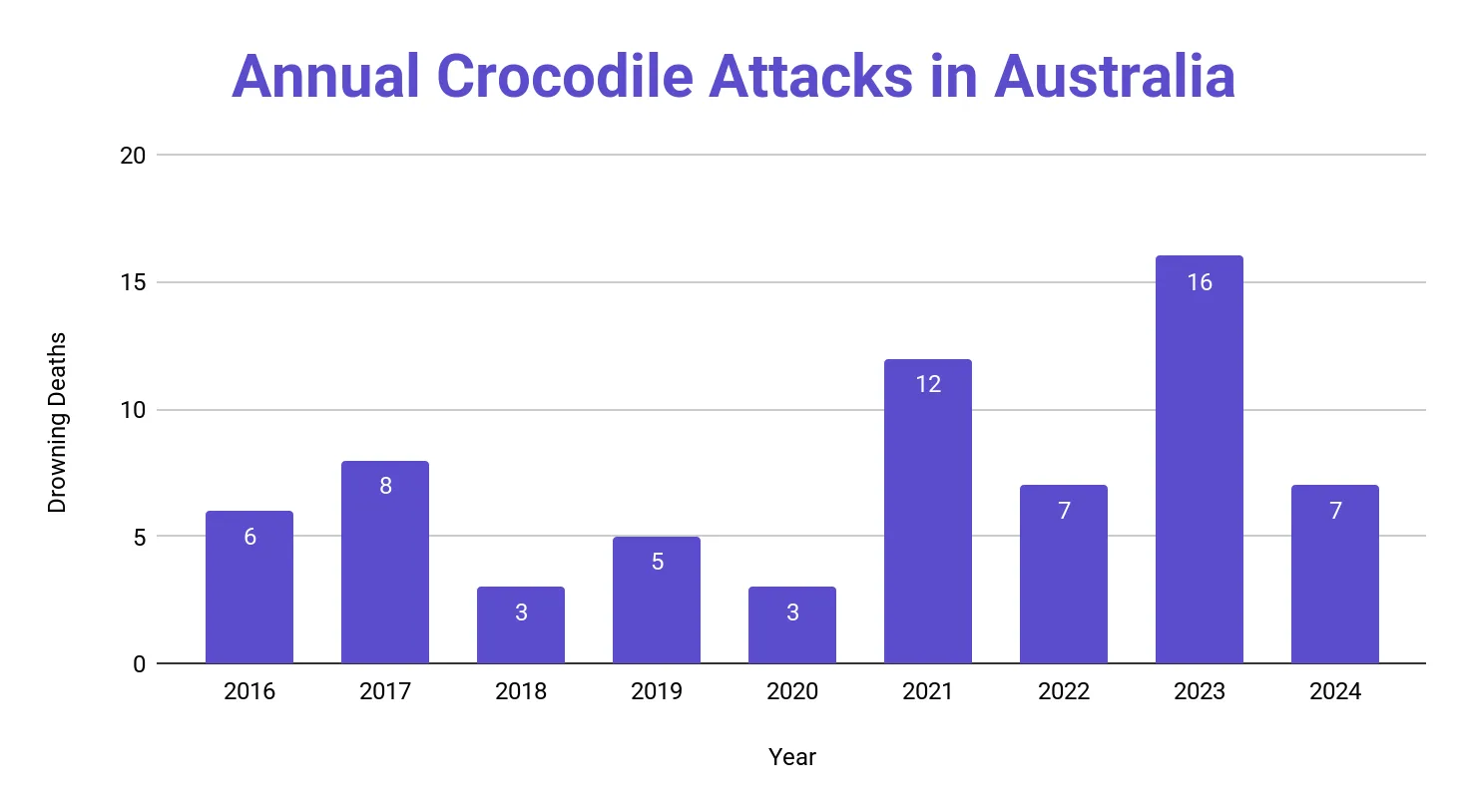
Crocodile attacks are rare in Australia, though the number of incidents has increased in recent years.
- From 2015 to 2024, annual crocodile attacks ranged from 3 to 16.
- 2023 recorded the highest number of attacks (16), while 2021 saw 12 attacks.
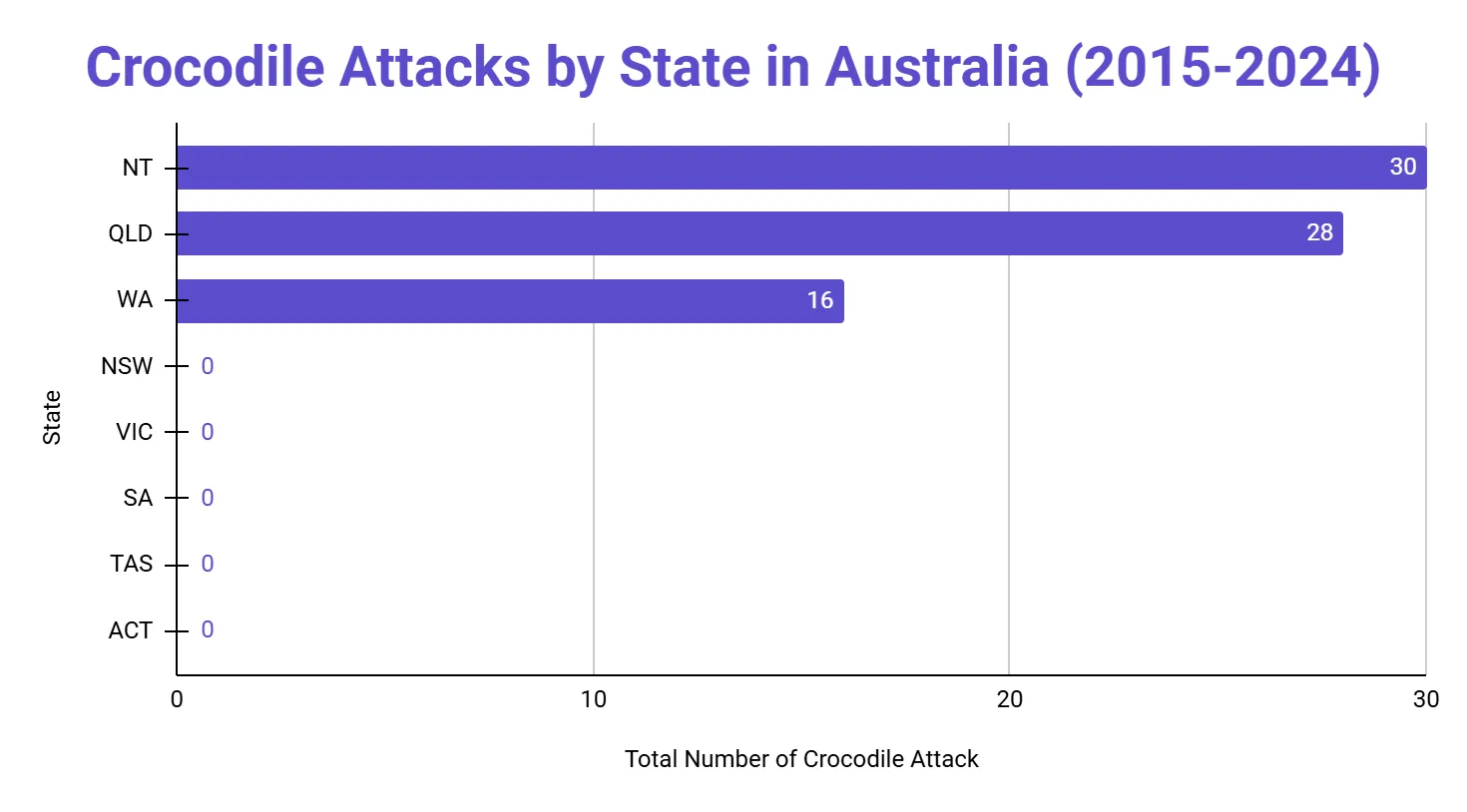
- Most incidents involved saltwater crocodiles and occurred in the Northern Territory (NT), Queensland (QLD), and Western Australia (WA).
How Many Crocodile Attacks Per Year Are Reported in Australia?
A total of 7 individuals were attacked by crocodiles in Australia in 2024.
- In the pre-pandemic years, crocodile attacks peaked in 2017, reaching 8 reported cases.
- In 2019, attacks rose by 66.7% to 5 cases from 3 attacks reported in 2018. When the COVID-19 pandemic began in 2020, incidents declined by 40.0% to 3.
- As water-based recreational activities resumed, attacks increased in 2021, reaching 12 cases. This then dropped by 41.7% to 7 in 2022.
- Australia reported the highest number of crocodile attacks in 2023, with 16 incidents, but this dropped by 56.3% to 7 cases in 2024.
How Many People Die from Crocodile Attacks Each Year?
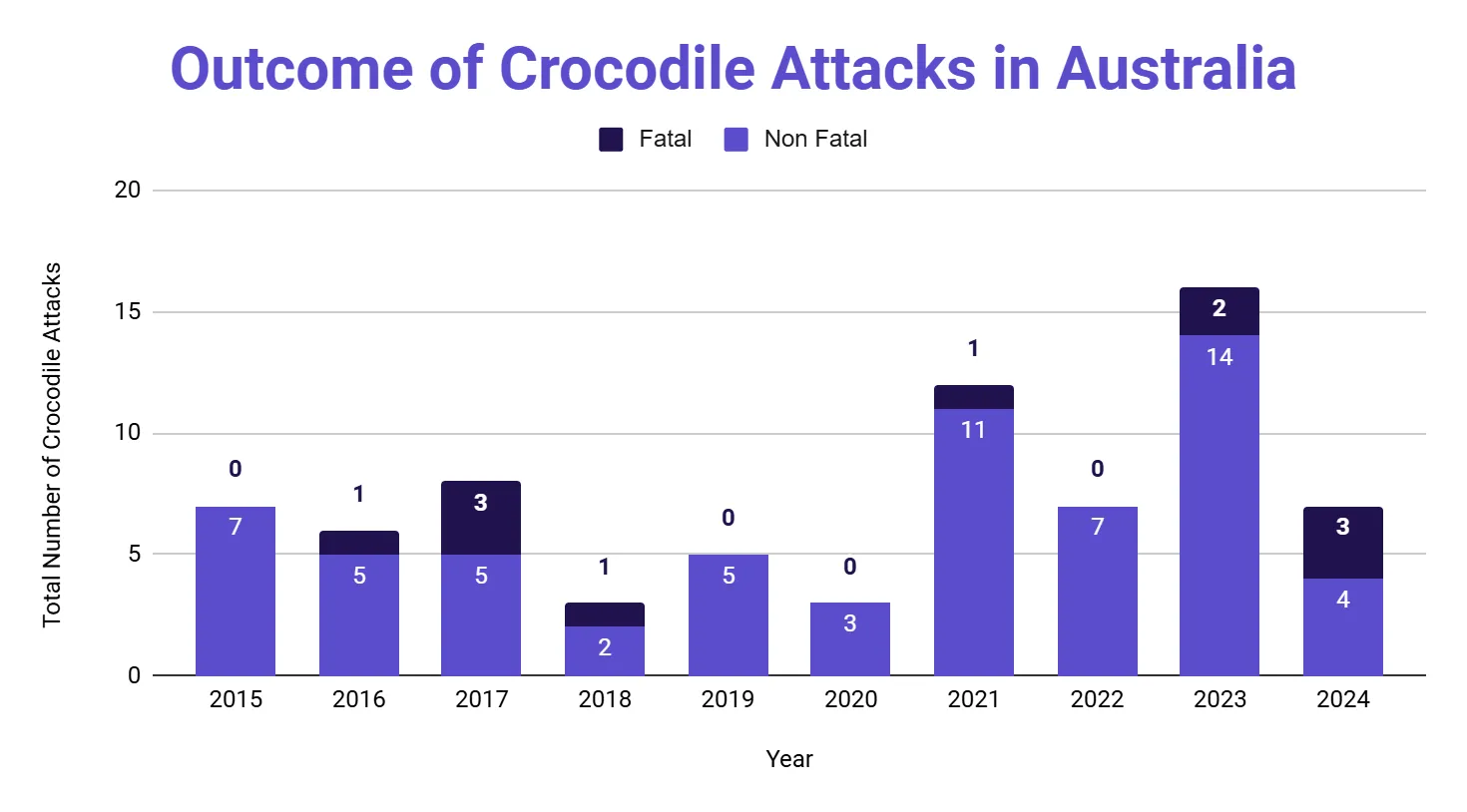
3 people died from crocodile attacks in Australia in 2024, making it the deadliest year since 2017.
- In 2017, there were 8 crocodile attacks, resulting in 3 fatalities — a number matched again in 2024 despite fewer overall attacks.
- Fatalities dropped to just 1 fatality in 2018 and 0 fatalities in 2019. No deaths were recorded in 2020 and 2022, while 1 fatality was reported in both 2016 and 2021.
- The number of deaths rose again to 2 in 2023 and climbed further in 2024, increasing by 50.0% compared to the previous year.
Which Regions in Australia Have the Most Crocodile Attacks?
The Northern Territory experienced the highest number of crocodile attacks from 2015 to 2024, with 30 recorded cases and 3 fatalities.
- Queensland follows closely behind with 28 incidents, accounting for the highest number of fatalities (7) among all states.
- Western Australia reported 16 attacks and one fatality, indicating a moderate but significant level of risk. Meanwhile, no crocodile attacks have been reported in southern states such as New South Wales, Victoria, South Australia, Tasmania, or the Australian Capital Territory.
Specific Types of Crocodile Attacks
Which crocodile species is responsible for most attacks in Australia?
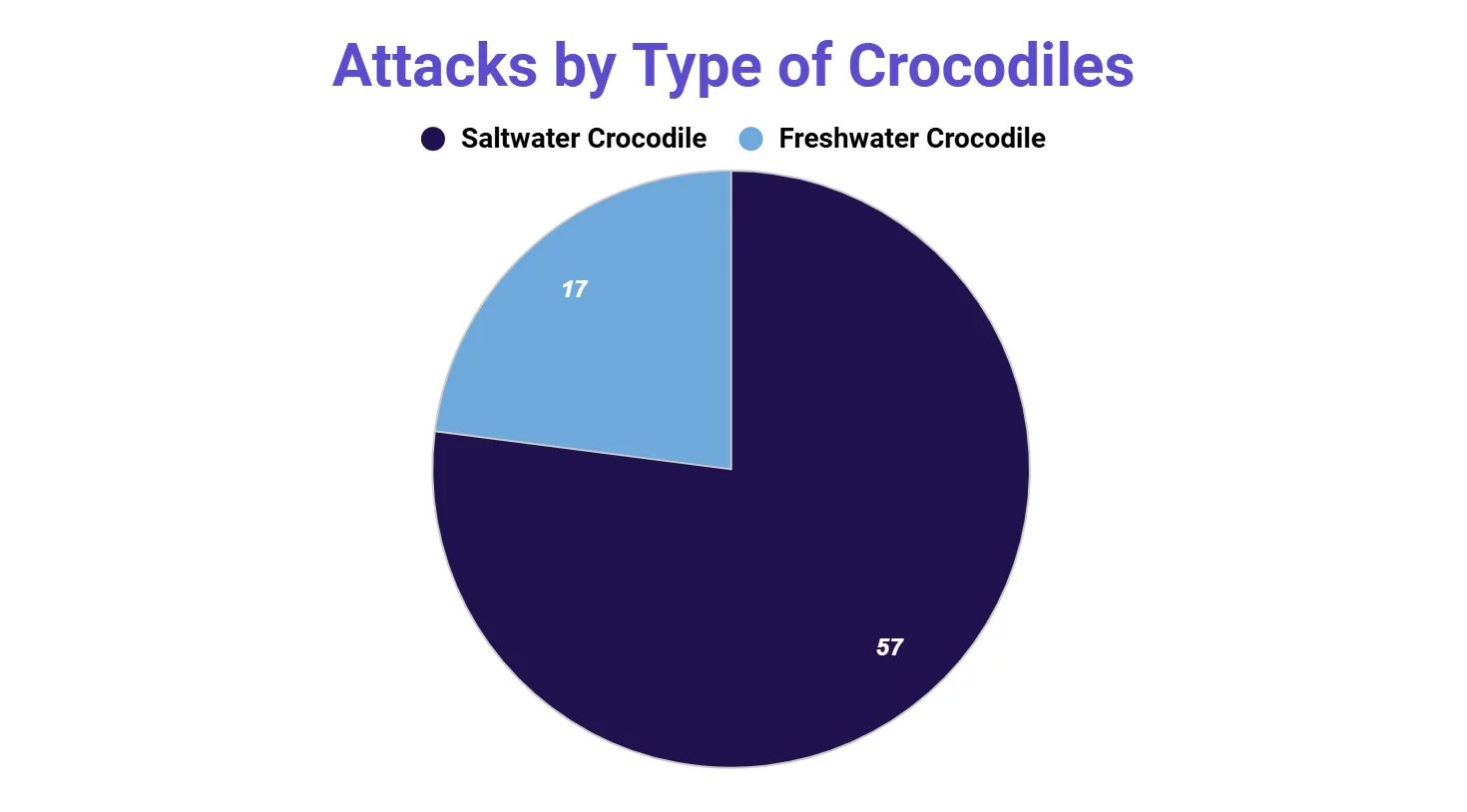
Saltwater crocodiles were responsible for 57 attacks and all 11 fatalities in Australia between 2015 and 2024. These large and aggressive reptiles are known for their ambush tactics and territorial nature, especially in tropical northern regions.
- Freshwater crocodiles accounted for 17 recorded attacks during the same period, with no reported fatalities, and although they are still capable of biting when provoked, they are far less dangerous.
Have There Been Kayak-Related Crocodile Attacks in Australia?
Only one confirmed kayak-related crocodile attack has been recorded in Australia between 2015 and 2024. The incident occurred in 2016 near Townshend Island, Queensland, when a saltwater crocodile lunged at a solo kayaker in open water.
- Although the victim was not injured, the crocodile struck the kayak with considerable force, highlighting how even non-aggressive encounters can present a serious risk in crocodile territory. The kayaker managed to escape by paddling to safety and later reported the event to authorities.
What Is the Deadliest Crocodile Attack Ever Recorded?
The deadliest crocodile attack ever recorded in Australia occurred in 1933 at Alligator Creek near Mackay, Queensland. In this tragic incident, two young sisters were killed by a crocodile while crossing the creek on horseback.
- The crocodile dragged the girls into the water, and only one of the bodies was recovered. Authorities later tracked and killed the crocodile, finding human remains in its stomach. This incident remains the only known double fatality from a single crocodile attack in Australian history.
- While more recent attacks typically involve single victims, the 1933 Alligator Creek case stands out for its severity, impact, and the young age of the victims.
Crocodile Attacks: Who are the Victims?
Age Distribution
Out of 11 crocodile-related fatalities, seniors aged 70 and above accounted for nearly half (5 out of 11 fatalities), making them the most vulnerable age group in fatal crocodile incidents.
- Adults aged 40–49 were tied for the second-highest risk group with teenagers (10–19), each accounting for 2 fatalities.
- Teenagers (10–19 years) also experienced 2 fatal attacks, often linked to swimming or playing near water.
- Surprisingly, there were no fatalities among children aged 0–9 or young adults aged 20–29, suggesting possible heightened awareness or supervision in these age brackets.
| Age Range | Fatalities |
|---|---|
| 0–9 | 0 |
| 10–19 | 2 |
| 20–29 | 0 |
| 30–39 | 1 |
| 40–49 | 2 |
| 50–59 | 0 |
| 60–69 | 1 |
| 70+ | 5 |
Gender Distribution
Males accounted for 7 out of the 11 deaths, making up 63.6% of all fatalities.
- Meanwhile, 4 female fatalities were recorded, accounting for the remaining 36.4%.
| Gender | Fatalities |
|---|---|
| Male | 7 |
| Female | 4 |
Other Resources
- Drowning Statistics in Australia
- Shark Attack Statistics in Australia
- Snake Bite Statistics in Australia
- Spider Bite Statistics in Australia
Notable Incidents and Survivors
Have There Been Attacks at Australia Zoo?
- Two non-fatal crocodile-related incidents have occurred at Australia Zoo: one involving a zookeeper in 2014 who was bitten during a feeding show.
- Another incident occurred in 2022 when Robert Irwin narrowly avoided a strike during a public demonstration. Despite these close calls, no fatalities have ever been recorded at the zoo.
Who Are Some Known Crocodile Attack Survivors?
- In 2023, Colin Deveraux made headlines after escaping a crocodile by biting its eyelid — an act of desperation that saved his life.
- That same year, Marcus McGowan survived a terrifying moment while snorkeling when a crocodile bit his head. He managed to break free and swim to safety.
- Back in 2017, Lee De Paauw was attacked after jumping into crocodile-infested waters on a dare. He survived by punching the crocodile until it released him.
- One of the most well-known cases dates back to 1985, when Val Plumwood survived a crocodile attack while canoeing in Kakadu National Park despite being dragged underwater multiple times.
What Increases the Risk of a Crocodile Attack?
Crocodile attacks are often triggered by human behaviour or environmental conditions, especially when individuals:
- Swim or wade in known crocodile habitats, especially at dawn, dusk, or night
- Use small boats in remote waterways without caution
- Ignore warning signs or local advice
- Consume alcohol, which has been a factor in several fatal incidents
References
- CrocBITE — Worldwide Crocodilian Attack Database · crocattack.org
- Australian Institute of Health and Welfare (AIHW) · aihw.gov.au