

Published
How Common Are Spider Bites in Australia?
Spider bites are relatively common in Australia, though most are not life-threatening.
- An estimated 2,000 Redback spider bites occur annually in Australia, though most are mild and never need hospital care.
- Approximately 923 hospitalisations due to spider bites occurred annually between 2001-2013.
- Spiders account for 30% of venomous bite admissions, second only to bees/wasps (33%).
- Since the introduction of antivenoms in 1981 (with Redback antivenom available since 1956), confirmed spider bite fatalities have been extremely rare.
How Many Spider Bites Per Year Are Reported in Australia?
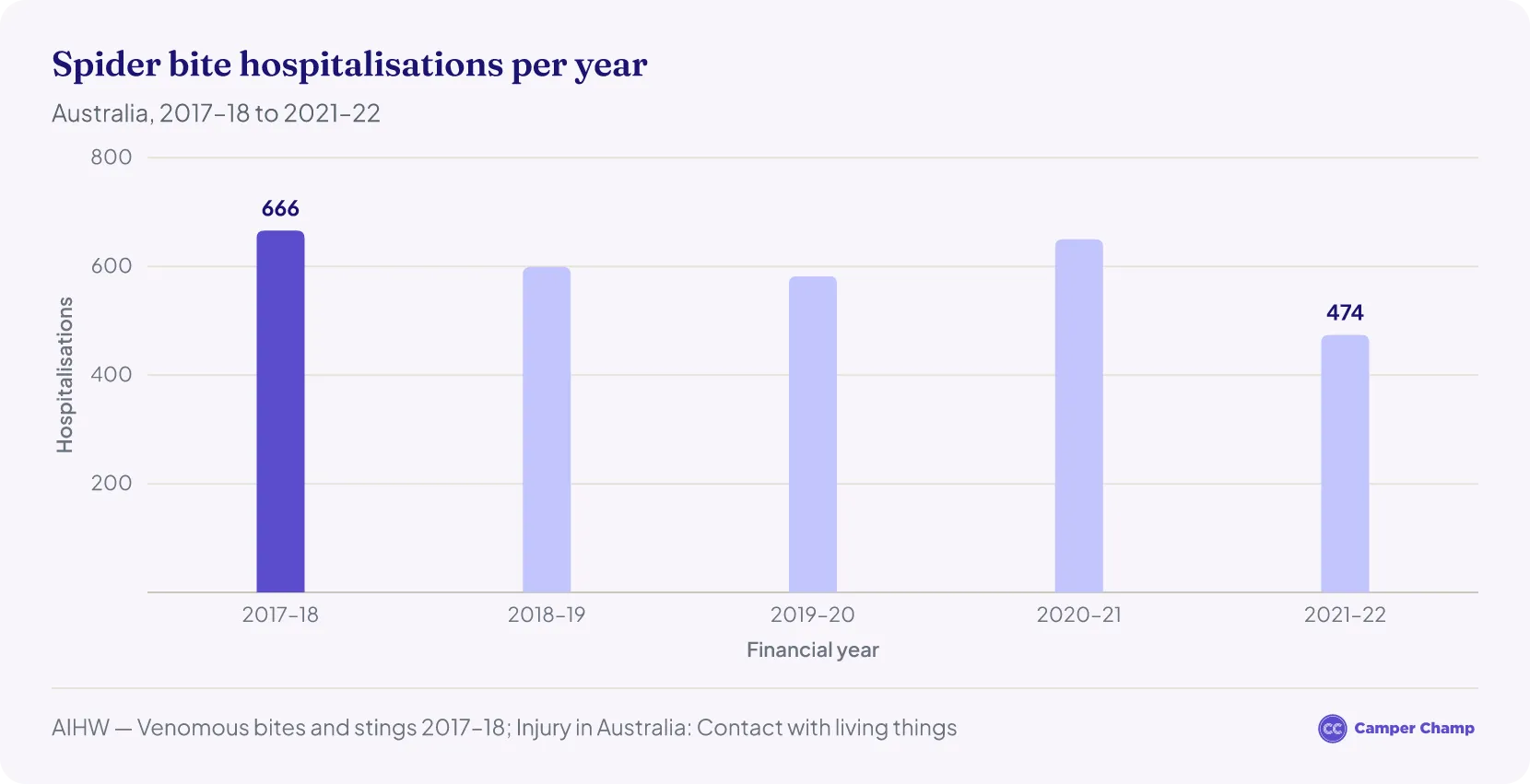
Australia records roughly 500 to 700 spider bite hospitalisations each year, on a gradual downward trend over the past decade.
- In the 2017–18, there were 666 hospital admissions for spider bites (19% of all venomous bite admissions).
- Admissions dipped to 599 in 2018–19 and 582 in 2019–20, then rose to 650 in 2020–21.
- In 2021–22 there were 474 spider bite hospitalisations — the lowest year in the published series; the AIHW notes a decade-long decline, with an uptick in 2023–24.
- Most bites are non-fatal and can be managed without hospital admission.
How Many People Die from Spider Bites Each Year?
Deaths from spider bites in Australia are now exceptionally rare thanks to effective antivenoms and medical care.
- From 2014 to 2024, only one person is recorded to have died from a spider bite in Australia.
- The single fatality occurred in 2016 when a 22-year-old male died after a spider bite during an Australian bushwalk.
- This was the first confirmed spider bite fatality in Australia in over 30 years.
Which Regions in Australia Have the Most Spider Bites?
New South Wales experiences a high number of bites, particularly from the endemic Sydney Funnel-web spider.
- Queensland reports numerous cases, primarily from Redback spiders in both urban and rural settings.
- Victoria and Western Australia have moderate-to-high rates of spider bites, mainly from Redback spiders.
- South Australia recorded 134 spider bite hospitalisations in 2013-14, with numbers peaking in spring/summer.
- Northern Territory has lower total numbers but a high per-capita rate (approximately 31 venomous bite hospitalisations per 100,000 people).
- Tasmania and the Australian Capital Territory report the lowest incidence of spider bites.
- Urban areas have lower incidence per capita (approximately 9 venomous bite and sting hospitalisations per 100,000 residents) but more total bites.
- Rural/remote regions experience higher per-capita rates (approximately 49 venomous bite and sting hospitalisations per 100,000 in very remote areas).
Note: Specific annual numbers of spider bites are not published online and regional data reflects reported hospitalisations and known species distributions.
Specific Types of Spider Bites
Which spider species is responsible for most bites in Australia?
The Redback spider (Latrodectus hasselti) is responsible for the largest share of medically significant spider bites in Australia.
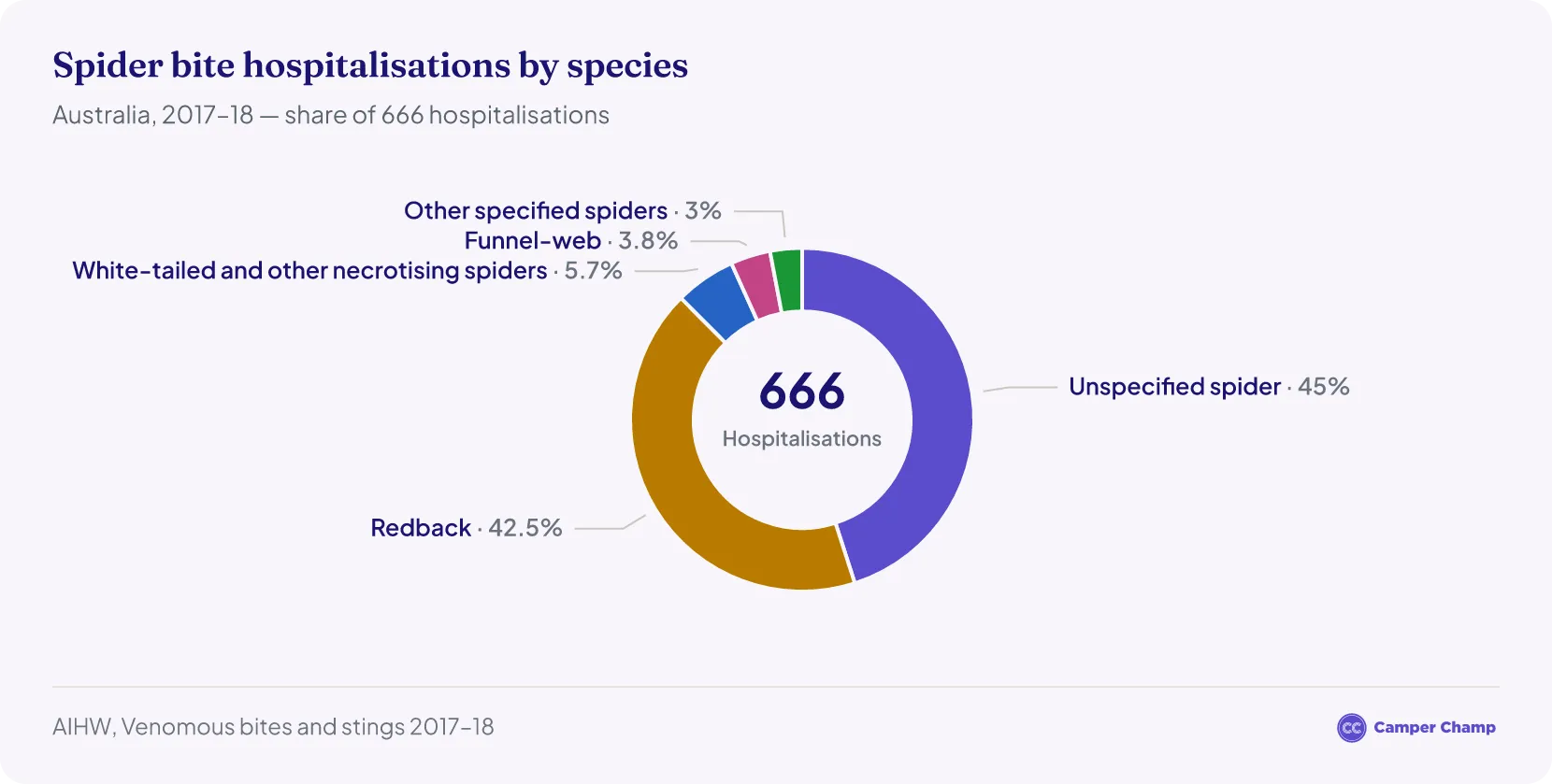
- Redback spiders account for 42.5% of spider bite hospitalisations (283 of 666 cases in 2017–18), and an estimated 2,000 Redback bites occur across Australia each year.
- The spider went unidentified in 45% of hospitalisations (300 cases).
- White-tailed and other necrotising spiders account for 5.7% (38 cases), though most bites cause only minor symptoms.
- Funnel-web spiders account for only 3.8% (25 cases) but are considered the most dangerous.
- Other identified species (huntsman, wolf spiders, etc.) make up the remaining 3% (20 cases).
Have There Been Confirmed Cases of Necrotic Skin Lesions from White-tailed Spider Bites?
Despite persistent myths, there is no scientific evidence that White-tailed spider bites cause necrotic skin lesions in Australia.
- A clinical study of 130 confirmed White-tailed spider bites found that 100% resulted in only minor effects with no necrotic ulcers.
- The belief that these spiders cause flesh-eating wounds has been thoroughly debunked by medical research.
- Skin necrosis attributed to spider bites is typically caused by other medical conditions or infections.
- White-tailed spider bites generally cause only mild illness with local pain and sometimes nausea.
What Is the Deadliest Spider Bite Ever Recorded?
The Sydney Funnel-web spider (Atrax robustus) is responsible for Australia's deadliest recorded spider bites.
- Between 1927 and the introduction of antivenom, Sydney Funnel-web spiders caused 13 recorded deaths in Australia.
- The venom contains a powerful neurotoxin that can cause severe symptoms within 15 minutes.
- Since the introduction of Funnel-web antivenom in 1981, no deaths have occurred from these spiders.
- Approximately 30-40 Funnel-web bites occur annually, with only around 10-15% causing envenoming serious enough to need antivenom.
- The development of the Funnel-web antivenom is considered one of Australia's greatest medical achievements.
Spider Bites: Who are the Victims?
Age Distribution
Spider bites occur across all age groups, though certain patterns emerge in the demographics of victims.
- Men aged 30-35 are the most likely to be bitten or stung, with a secondary peak among children aged 5-9.
- Middle-aged adults also experience a high number of bites, often during outdoor or household activities — several sting categories peaked among 45-64-year-olds in 2017–18.
- In clinical studies, confirmed spider bite victims have ranged from 3 to 76 years old.
- Elderly individuals may be more vulnerable to severe effects if bitten.
- Young children are at higher risk due to their smaller body mass relative to venom dose.
| Age Range | Risk Level | Notes |
|---|---|---|
| 0-4 | Moderate-High | Vulnerable due to small body mass |
| 5-14 | High | Secondary peak (ages 5-9) for venomous injuries |
| 15-39 | Moderate | Includes the overall peak: men aged 30-35 |
| 40-59 | Moderate-High | Second peak for bite incidents |
| 60+ | Moderate | Potentially more severe outcomes |
Gender Distribution
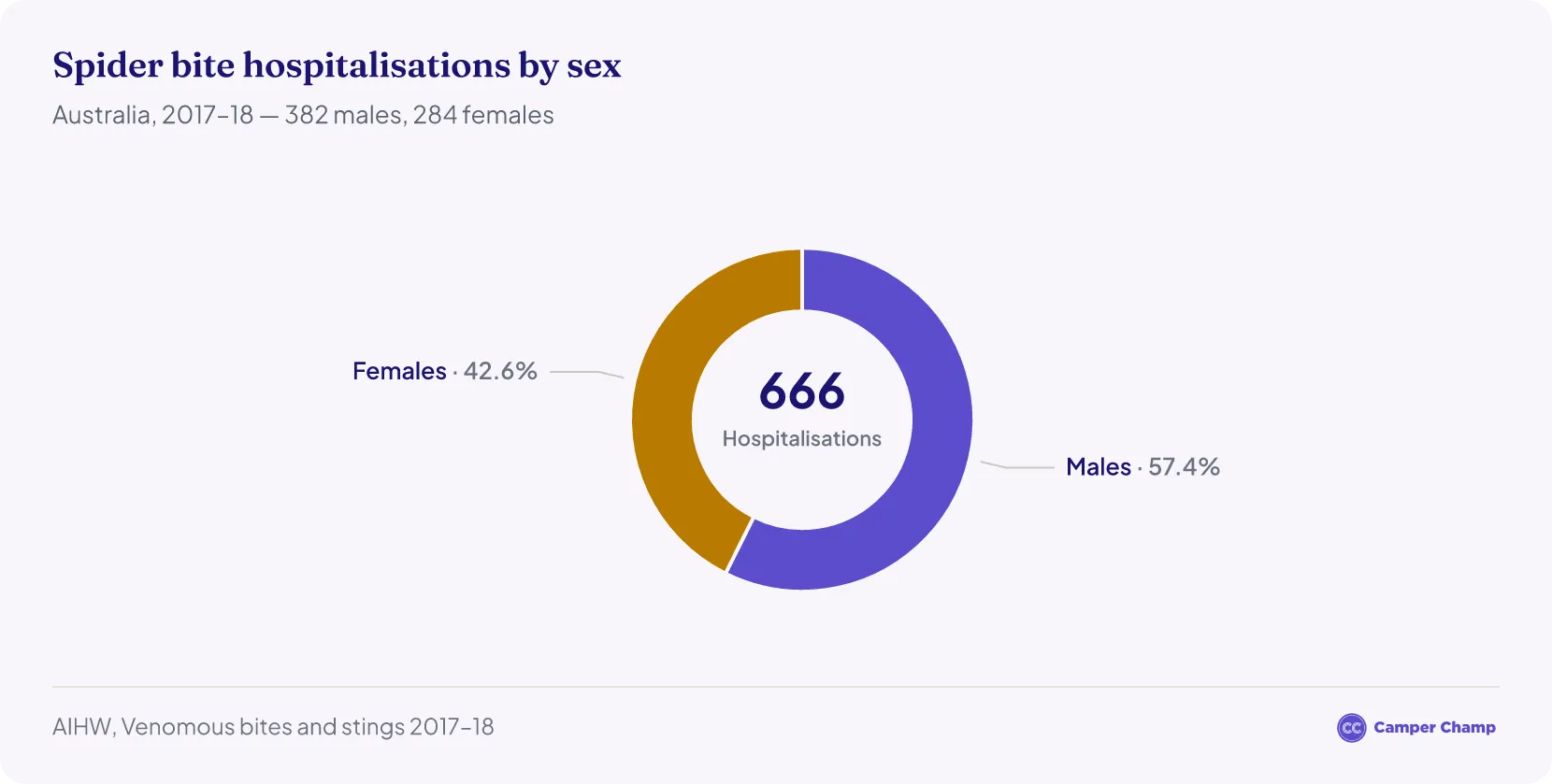
Males account for 57% of spider bite hospitalisations in Australia (382 of 666 cases in 2017–18), with females representing the remaining 43% (284 cases).
- The higher incidence among males is likely related to occupational and recreational exposure.
- Aggregated data on venomous bites from 2001-2013 showed that 64% of victims were male.
- Men working in outdoor occupations such as construction, landscaping, and agriculture face increased risk.
- Both genders commonly encounter spiders during domestic activities like gardening and home maintenance.
Other Resources
- Crocodile Attack Statistics in Australia
- Drowning Statistics in Australia
- Shark Attack Statistics in Australia
- Snake Bite Statistics in Australia
Notable Incidents and Risk Factors
What Activities Increase the Risk of Spider Bites?
- Gardening or yard work without gloves increases the chance of disturbing hidden spiders and getting bitten.
- Cleaning sheds, garages, or storage areas exposes individuals to spiders that hide in undisturbed places.
- Reaching into shoes, containers, or mailboxes without checking first can lead to accidental bites.
- Wearing unshaken clothing or footwear left outside raises the risk of spider encounters.
- Outdoor work or activities during warmer months increase exposure to active spider habitats.
When Are Spider Bites Most Common?
Spider bites in Australia show clear seasonal and temporal patterns, and usually the spring, summer and early autumn months (September through April) see the highest numbers of spider bites.
- Most bites occur between 8:00 AM and midnight when people are most active.
- Late summer and autumn typically experience a surge in Redback spider bites.
- Bites are less common during winter months when spider activity decreases.
- Funnel-web spiders are more active after rainfall, increasing bite risk during wet periods.
What Reduces the Severity of Spider Bites?
- Antivenoms have virtually eliminated deaths from both Redback (since 1956) and Funnel-web (since 1981) spider bites.
- Improved first aid knowledge, such as the pressure immobilisation technique for Funnel-web bites, helps reduce the severity of spider bites.
- Greater public awareness about high-risk areas and preventive measures contributes to reducing bite severity.
- Faster access to medical care, especially in urban and regional centres, further mitigates severe outcomes.
- Better identification of dangerous spider species by both the public and medical professionals improves treatment response.
- Preventive measures, such as wearing gloves during gardening and shaking out shoes before wearing them, help lower the risk of spider bites.
How Has the Treatment of Spider Bites Evolved?
The management of spider bites in Australia has advanced significantly over recent decades:
- Redback antivenom became available in 1956, and roughly 250 doses were once administered annually — use has fallen sharply since a 2014 trial questioned its benefit.
- Funnel-web antivenom was developed in 1981 and has been given to at least 100 patients with 100% survival.
- Modern pressure immobilisation bandaging techniques help slow venom spread for Funnel-web bites.
- Cold pack application is now recommended for Redback spider bites to reduce pain.
- Unnecessary antivenom use for minor bites has been reduced based on evidence that many cases resolve without it.
- Improved pain management protocols have been established for the intense pain associated with Redback bites.
- Enhanced monitoring techniques have been implemented to identify patients requiring more aggressive intervention.
References
- AIHW — Venomous bites and stings · aihw.gov.au
- National Coronial Information System (NCIS) · ncis.org.au
- Australian Museum · australian.museum
- PubMed · pubmed.ncbi.nlm.nih.gov