

Published
At a glance
Snakes bite around 3,000 Australians a year, but only a handful die. Hospital admissions for snake bites have climbed to a decade high, Queensland has by far the most bites, and brown snakes cause most deaths.
- Bites: around 3,000 a year across Australia1.
- Hospital admissions: about 3,240 snake-related admissions in 2024–25, the highest in a decade.2
- Deaths: between 3 and 8 a year in official data, with 3 in 2023–242.
- Worst state: Queensland, with about half of all admissions (1,479 of 2,993 in 2023–24)3.
- Deadliest snake: brown snakes, behind 41% of confirmed envenomings and 17 of 23 deaths in 2005–20154.
- Latest death: September 2025, in Katherine, Northern Territory5.
- Snake season: roughly October to April, peaking from December to February6.
- First aid: call 000, keep the person still and apply a pressure immobilisation bandage7.
How common are snake bites in Australia?
Around 3,000 people are bitten by snakes in Australia each year1, but deaths are rare — no more than 8 in any year of the past decade2. Queensland records the most bites, and brown snakes cause most deaths.
- Venomous snakes and lizards caused 855 of about 2,250 hospital admissions for contact with venomous animals and plants in 2024–25 (about 38%), more than venomous spiders (544)2.
- Counting every snake bite admission (venomous, non-venomous or unknown), that is about 12 per 100,000 people in 2024–25, up from about 10 in 2015–162.
- Brown snakes caused 17 of the 23 snake bite deaths recorded by the Australian Snakebite Project from 2005 to 20154.
- In the Australian Snakebite Project, about half of hospital patients with a suspected snake bite (835 of 1,548) were envenomed, and 755 received antivenom4 — though the study notes milder, non-envenomed bites were likely under-recruited.
- Campers, caravanners and campervan travellers are most exposed in snake season, roughly October to April6, when both snakes and people are most active outdoors8.
How many snake bites are there in Australia each year?
Australia is often said to have around 3,000 snake bites a year, but that is an older estimate not based on any published study4, and hospital admissions alone have now passed it.
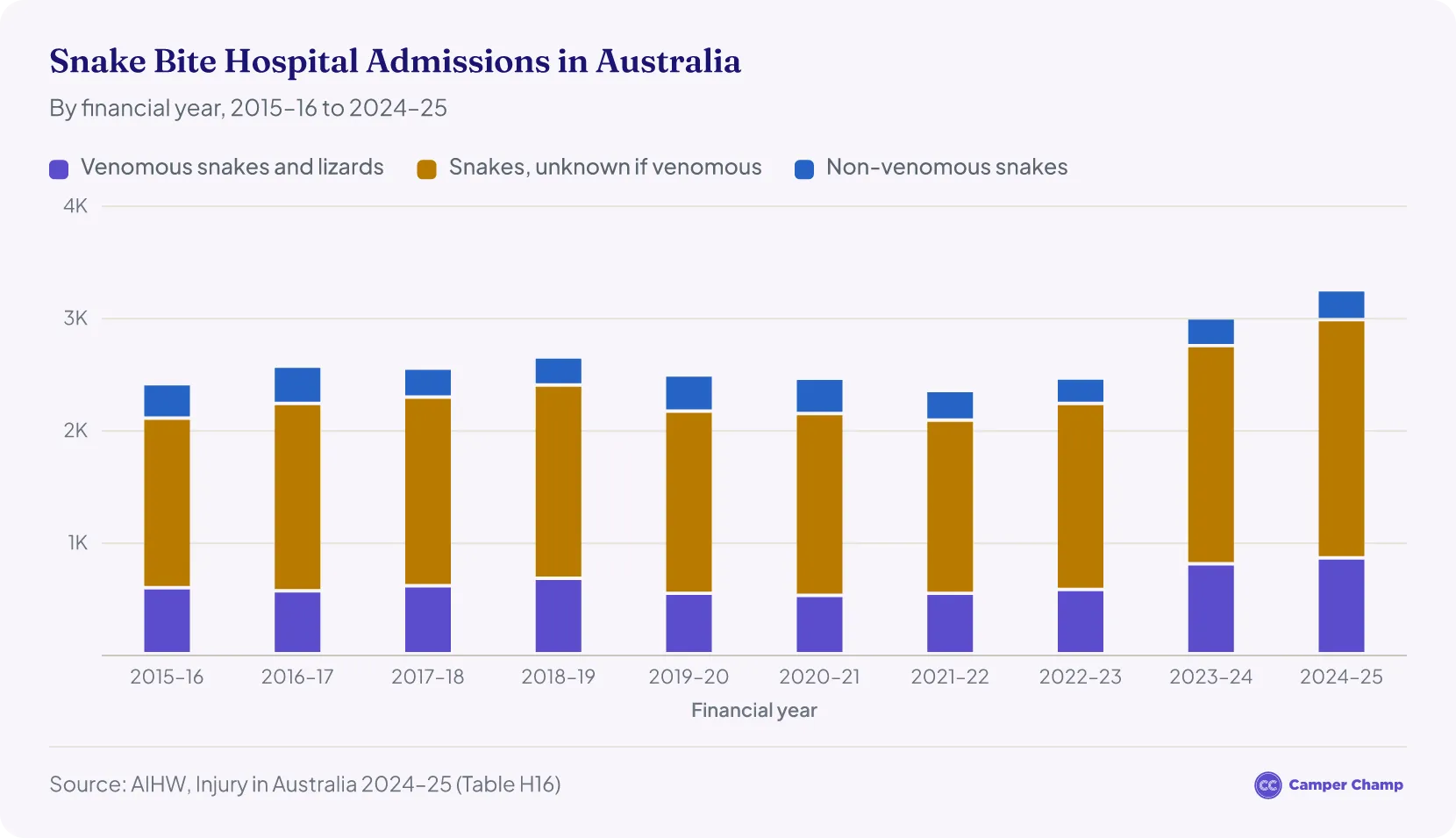
- Snake-related hospital admissions have risen from about 2,410 in 2015–16 to about 3,240 in 2024–25, the highest in the decade.2
- Admissions dipped during the pandemic years, to about 2,350 in 2021–22, before climbing again.2
- Queensland alone recorded 846 snake bite call-outs (initial requests for medical assistance) in 2022 and 986 in 20239, consistent with the national pattern.
- Official hospital data tells a rising story: admissions for venomous snake and lizard bites reached 855 in 2024–25, the highest in a decade and up from 588 in 2015–162. A further 2,122 admissions that year were snake bites where it was unknown whether the snake was venomous.
Note: The 3,000 figure is a rough estimate that predates current hospital data, which counted about 3,240 admissions in 2024–25 alone. The chart shows hospital admissions only (AIHW totals across venomous, unknown and non-venomous snake bites).
| Snake bite hospital admissions in Australia by year | |||
|---|---|---|---|
| Financial year | Venomous snakes and lizards | Snakes, unknown if venomous | Non-venomous snakes |
| 2015–16 | 5882 | 1,5112 | 3072 |
| 2016–17 | 5612 | 1,6692 | 3332 |
| 2017–18 | 6062 | 1,6812 | 2582 |
| 2018–19 | 6722 | 1,7222 | 2502 |
| 2019–20 | 5392 | 1,6222 | 3232 |
| 2020–21 | 5212 | 1,6202 | 3132 |
| 2021–22 | 5392 | 1,5422 | 2652 |
| 2022–23 | 5742 | 1,6572 | 2252 |
| 2023–24 | 8022 | 1,9432 | 2482 |
| 2024–25 | 8552 | 2,1222 | 2652 |
Source · AIHW, Injury in Australia 2024–25, supplementary data table H16 (injury hospitalisations by cause).
How many people die from snake bites each year?
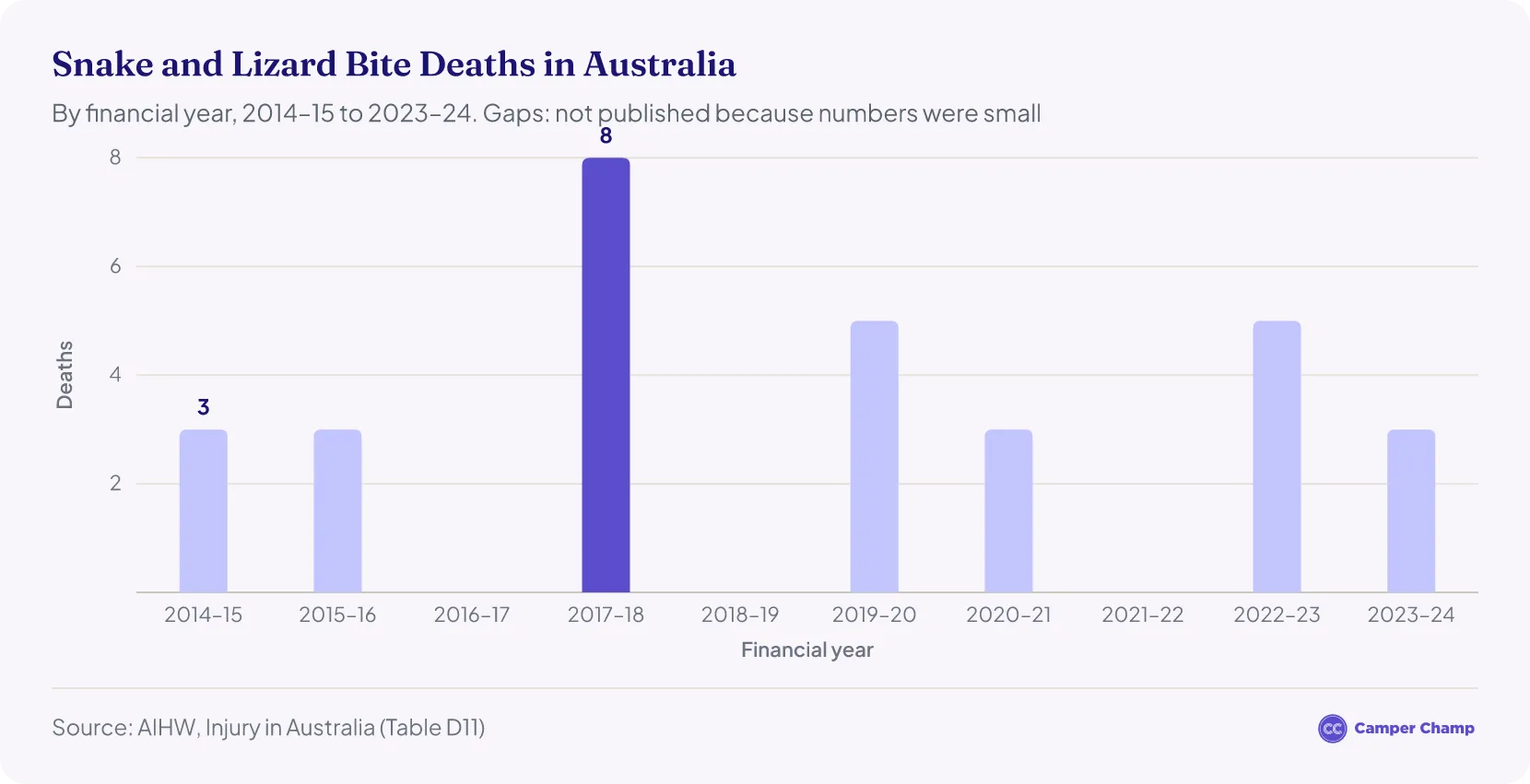
Snake bites kill only a handful of Australians each year. Official injury data recorded between 3 and 8 deaths a year from venomous snake and lizard bites from 2014–15 to 2023–24, in the years where figures were published2.
- In 2023–24, the latest year available, 3 deaths were recorded2.
- 2017–18 was the deadliest year of the decade, with 8 deaths2. Figures for 2016–17, 2018–19 and 2021–22 were not published because the numbers were small.
- Most people who are envenomed survive: of 835 envenomed patients in the Australian Snakebite Project (2005–2015), 23 died4.
- Worldwide, snake bites kill an estimated 81,410 to 137,880 people a year, mostly in Africa, Asia and Latin America10, which puts Australia's handful of deaths a year in perspective.
How do snake bites compare with other dangerous animals in Australia?
Snakes bite far more Australians than any other dangerous wild animal, yet they kill only a handful of people a year.
- Snakes: about 3,000 bites a year1, and 3 deaths in 2023–242.
- Crocodiles: 74 attacks and 11 deaths from 2015 to 202411 (see our crocodile attack statistics).
- Sharks: 19 recorded incidents, including 13 unprovoked bites, and 1 death in 202412.
- Spiders: an estimated 2,000 redback bites a year, and no deaths from a confirmed spider bite since 197913 (see our spider bite statistics).
For more species, see our Australian wildlife statistics.
Which state has the most snake bites in Australia?
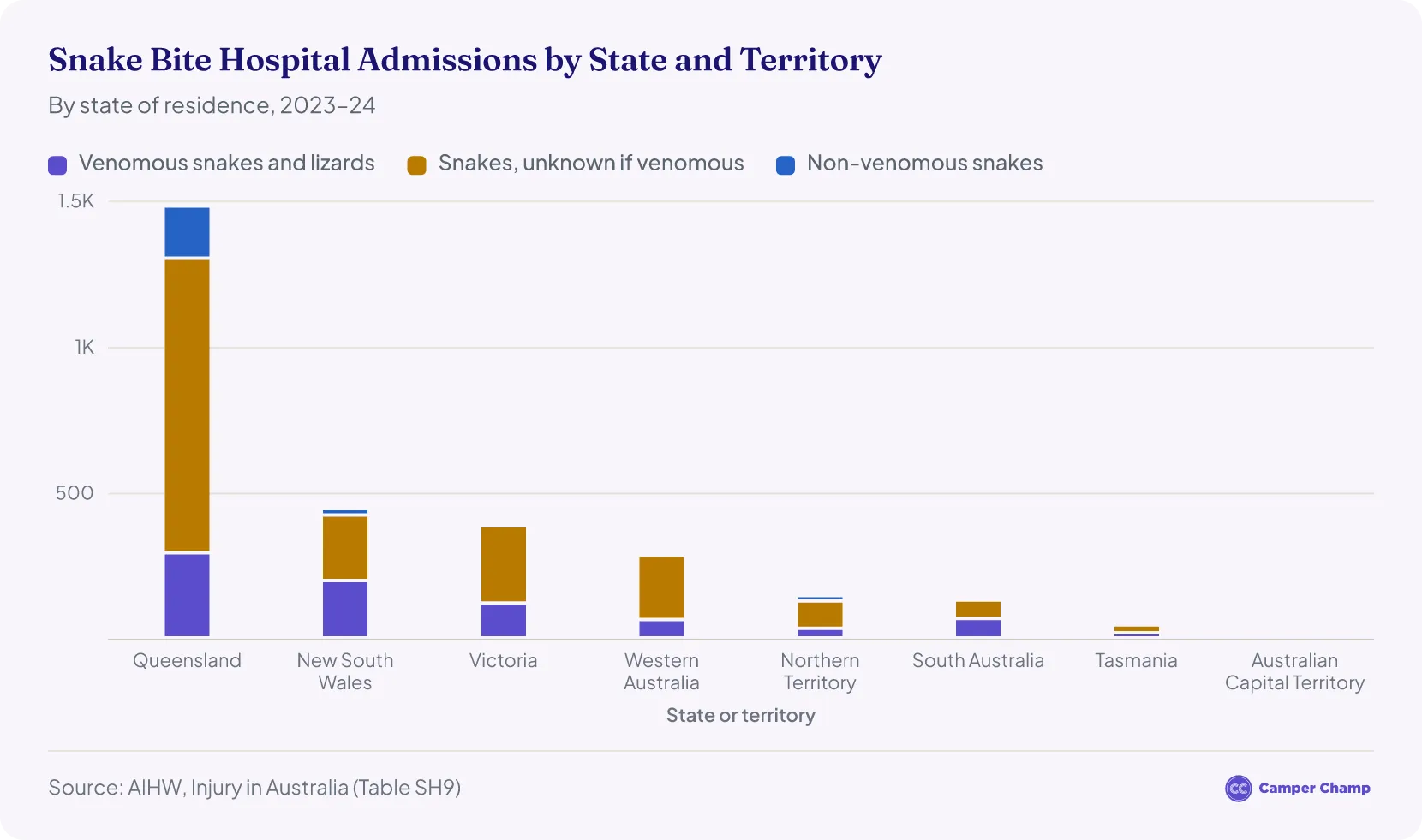
Queensland has by far the most snake bite hospital admissions in Australia, every year in the official data3.
- Queensland residents accounted for 1,479 of the 2,993 snake bite hospital admissions in 2023–24, about half the national total3.
- New South Wales was second with 443 admissions, just ahead of Victoria with 3933.
- Western Australia recorded 292 admissions, the Northern Territory 145 and South Australia 1353.
- Tasmania (at least 45) and the Australian Capital Territory (at least 13) had the fewest. Some of their counts are too small to publish3.
- Relative to population, the Northern Territory has the highest rate of snake bite admissions, ahead of Queensland3.
Note: These are hospital admissions by state of residence for 2023–24, the latest year AIHW breaks down by state. They add up to the national total of about 3,000. Bites treated without a hospital admission are not counted.
Which snakes cause the most bites in Australia?
Brown snakes, led by the eastern brown snake (Pseudonaja textilis), cause the largest share of snake bites and deaths, accounting for 41% of envenomings where the snake type was confirmed in the Australian Snakebite Project (2005–2015)4.
| Snake bite frequency by species in Australia | |
|---|---|
| Snake species | Share of confirmed envenomings |
| Brown snakes (incl. eastern brown) | 41%4 |
| Tiger snakes | 17%4 |
| Red-bellied black snake | 16%4 |
| Other confirmed snakes (incl. death adders and taipans) | 26%4 |
Source · Australian Snakebite Project, 2005–2015: share of the 718 envenomed patients whose snake type was confirmed.
What is the deadliest snake in Australia?
The eastern brown snake is Australia's deadliest snake. Brown snakes caused 17 of the 23 snake bite deaths recorded by the Australian Snakebite Project from 2005 to 2015, and tiger snakes caused four4.
- The inland taipan has the most toxic venom of any snake in laboratory tests, but it is shy and lives in remote semi-arid country, so people rarely come across it15.
- Its relative, the coastal taipan, is far more common and fiery-tempered, which makes it more dangerous to people than the inland taipan15.
- Eastern brown bites can be painless and leave little trace, so some people don't realise they have been bitten until they become critically unwell16.
When was the last snake bite death in Australia?
The most recent reported snake bite death in Australia was in September 2025, when a 41-year-old woman died in Katherine, Northern Territory, within an hour of stepping on a snake on a suburban footpath. She saw no bite marks and did not realise she had been bitten5.
- In November 2024, a 16-year-old boy died after being bitten on the foot at his home near Gladstone, Queensland. He had not realised he had been bitten; the snake type was not confirmed16.
- In March 2024, a 47-year-old man died after multiple bites from a brown snake he had caught at a Townsville childcare centre17.
- Official data recorded 5 snake and lizard bite deaths in 2022–23 and 3 in 2023–242.
- Not every serious bite is fatal: in October 2024, Lovisa "Kiki" Sjoberg, 48, survived almost two weeks lost in the Snowy Mountains, the last four days after being bitten by a snake (believed to be a copperhead)18.
Who gets bitten by snakes in Australia?
Snake bites by age
Adults aged 25–44 account for the largest share of venomous snake bite hospital admissions in Australia, about a third (33%) from 2002 to 20206.
- Middle-aged adults (45–64 years) make up about 29% of admissions6.
- Children under 15 make up about 15%, and young people aged 15–24 about 14%6.
- Seniors (65+ years) account for the smallest share, at about 9%6.
Snake bites by gender
There is a significant gender disparity in snake bite victims, with males being much more frequently affected.
When is snake season in Australia?
Snake season in Australia runs through the warmer months, roughly October to April6. Snake bite hospital admissions peak from December to February, at almost five times the winter level. Snakes are sluggish over winter and become active again as temperatures rise, just as people head outdoors to hike, garden and walk dogs.
- The NSW Poisons Information Centre took 320 calls about suspected or confirmed snake bites between 1 September and 20 December 20241.
- 61 snake bites in children under 15 were reported across NSW over the same period1.
- A warm winter can bring snakes out early: in 2024 they were active earlier than after previous, cooler winters1.
What increases your risk of a snake bite in Australia?
Several factors significantly increase the risk of snake bites in Australia:
- Attempting to handle or kill snakes: 14% of bites in the Australian Snakebite Project happened while trying to catch or kill the snake4, and about one fifth of people who died were bitten while trying to pick one up14.
- Outdoor activities: Almost half of bites (47%) happen while walking or doing something else near a snake without noticing it, and 8% while gardening4.
- Warmer weather: Most snake bites occur during the warmer months (October to April)6 when snakes are more active.
- Living or travelling outside cities: 57% of snake bite patients are treated at regional or remote hospitals4, though nearly half of fatal bites happen in urban areas14.
- Camping and caravanning: Campsites, showgrounds and rest areas often sit beside long grass, woodpiles and bush where snakes shelter19. In very remote areas, the snake bite hospitalisation rate is nearly 15 times that of major cities6.
- Environmental changes: Urbanisation and habitat destruction can force snakes into residential areas, increasing human encounters.
- Being unprepared or inattentive: Not seeing snakes before stepping on them or reaching into their hiding places is a common cause of bites.
- Distance from medical help: While not increasing the risk of being bitten, being far from medical assistance significantly worsens outcomes.
Are snakes a risk when camping, caravanning or hiking in Australia?
The risk is small for campers, caravanners and campervan travellers, but distance from help is what makes a bite in the bush dangerous. Of 85 people the Royal Flying Doctor Service flew to hospital from regional and remote Western Australia with suspected snake bites, only 5 (6%) turned out to be envenomed — yet 45% kept moving around after the bite, and it took an average of 38 minutes to get a pressure bandage on8.
Snake safety at your campsite, caravan or campervan
- Put shoes on before you step out of your caravan or campervan at a new site, and wear enclosed shoes around camp19.
- Walk the site before you set up and avoid long grass, firewood piles, garden waste and building debris, where snakes shelter19.
- Keep van doors and screens closed and sealed, so snakes following lizards or looking for cover can't get in19.
- Carry a torch when walking around camp at night19.
- Store food and rubbish in sealed containers, away from animals20.
- Carry broad elastic pressure bandages in your first aid kit, enough to bandage a whole limb.
- Wear long trousers in long grass, and watch where you step and put your hands.
- Outside mobile coverage, carry a way to call for help, such as a satellite messenger or personal locator beacon8.
- Never try to catch or kill a snake: back away and give it room to leave.
- If you are bitten, don't walk back to camp or your van. Stay still, apply a pressure bandage and call for help19.
- Before heading somewhere remote, leave your trip plans with someone at home20.
Planning a trip? See our Australian camping statistics, our Australian hiking statistics and our guide to wild camping rules.
Campervan hire in Australia
How to treat a snake bite in Australia: first aid and hospital care
Australian first aid guidelines recommend the pressure immobilisation technique for every suspected snake bite, even when there are no bite marks or pain7:
- Call triple zero (000) for an ambulance.
- Keep the person still, calm and under constant observation.
- Apply a broad pressure bandage over the bite site, then bandage the entire limb.
- Immobilise the limb with a splint or sling, and keep the person still until help arrives.
What not to do:
- DO NOT wash the bite area (venom residue can help identify the snake)
- DO NOT cut the wound or attempt to suck out venom
- DO NOT apply a tourniquet or ice
- DO NOT try to catch or kill the snake to identify it — it risks more bites and isn't needed for treatment8
How are snake bites treated in hospital?
Doctors decide whether to give antivenom based on where the bite happened, the person's symptoms and blood tests, usually with advice from a toxicologist8.
- Of 1,548 people treated for suspected snake bites in the Australian Snakebite Project (2005–2015), 835 were envenomed and 755 received antivenom4.
- The typical antivenom dose fell from four vials to one vial over the decade4.
- The median wait from bite to first antivenom was 4.3 hours, so first aid matters while help is on the way4.
- Ten of the 23 deaths in the study followed a cardiac arrest before the person reached hospital4.
Other resources
- Crocodile Attack Statistics in Australia
- Shark Attack Statistics in Australia
- Spider Bite Statistics in Australia
References
- Cases of snake bites rise in NSW, with warmer weather and urbanisation possible factors in increase · abc.net.au ↑ b c d e f
- Injury in Australia — supplementary data tables (hospitalisations to 2024–25) · aihw.gov.au ↑ b c d e f g h i j k l m n o p q r s t u v w x y z a2 b2 c2 d2 e2 f2 g2 h2 i2 j2 k2 l2 m2 n2 o2 p2 q2
- Injury in Australia — supplementary data tables by state and territory · aihw.gov.au ↑ b c d e f g
- The Australian Snakebite Project, 2005–2015 (ASP-20) · mja.com.au ↑ b c d e f g h i j k l m n o p q r s t u
- Woman's snake bite death in Katherine sparks warnings against complacency · abc.net.au ↑ b
- Trends in injury hospitalisations due to contact with snakes in Australia, 2002 to 2020 (Australian Venomous Injuries Project) · pmc.ncbi.nlm.nih.gov ↑ b c d e f g h i j k l
- ANZCOR Guideline 9.4.1 – First Aid Management of Australian Snake Bite · anzcor.org ↑ b
- Snakes are waking up. What should you do if you're bitten? And what if you're a long way from help? · uwa.edu.au ↑ b c d e
- What makes the eastern brown snake so deadly? · abc.net.au ↑
- WHO — Global Snakebite Incidence and Mortality by Country · who.int ↑
- CrocAttack — 2015–2024 attack statistics · crocattack.org ↑
- Australian Shark Incident Database — Annual report summary 2024 · taronga.org.au ↑
- Spider facts — The Australian Museum · australian.museum ↑
- Fatal snake bites in Australia: facts, stats and stories · unimelb.edu.au ↑ b c
- Inland Taipan · australian.museum ↑ b
- Teenage boy dies after being bitten by snake in rural Gladstone · abc.net.au ↑ b
- Man dies after being bitten by eastern brown snake in Townsville · abc.net.au ↑
- Lovisa Sjoberg found alive after almost two weeks lost in Kosciuszko National Park · abc.net.au ↑
- Grey nomads given tips on best way to stay safe from snakes · thegreynomads.com.au ↑ b c d e f
- Camping safety — NSW National Parks and Wildlife Service · nationalparks.nsw.gov.au ↑ b
- Australian Institute of Health and Welfare (AIHW) · aihw.gov.au
- AVRU — Venom Research, Snake Species Profiles, and Antivenom Studies · biomedicalsciences.unimelb.edu.au
- RFDS — Emergency Response Data and Remote Snakebite Treatment Cases · flyingdoctor.org.au