

Updated
At a glance
- 267,363 people visited Uluru-Kata Tjuta National Park in 2024–25, up 9.0% on 2023–24.1
- That is about a third below the 2018–19 peak of 395,338, the last full year before the Uluru climb closed.2
- About 733 people a day visited the park on average in 2024–25.1
- July is the busiest month, with 57,017 visitors in July 2019.2
- A three-day adult park pass costs $38 in 2026, and under-18s enter free.3
- Overnight visitors to the Uluru region spent an average of $316 million a year over 2020–2024.4
How many people visit Uluru each year?
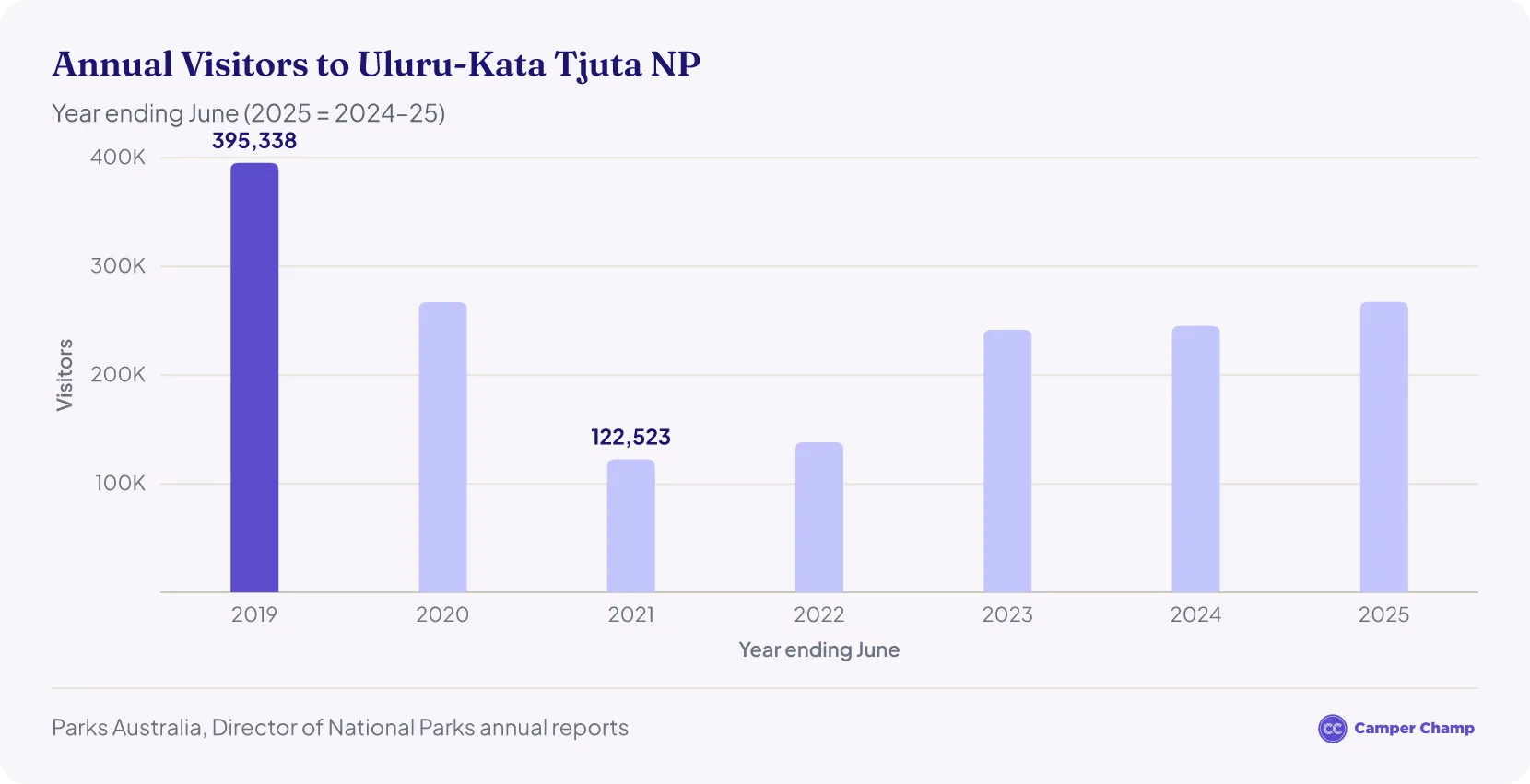
| Uluru visitor numbers by year | ||
|---|---|---|
| Financial year | Visitors | Change on previous year |
| 2024–25 | 267,363 | +9.0% |
| 2023–24 | 245,238 | +1.4% |
| 2022–23 | 241,788 | +74.8% |
| 2021–22 | 138,329 | +12.9% |
| 2020–21 | 122,523 | −54.1% |
| 2019–20 | 267,109 | −32.4% |
| 2018–19 | 395,338 | — |
How did closing the Uluru climb affect visitor numbers?
Visitor numbers rose sharply in the lead-up to the Uluru climb closing on 26 October 2019. Parks Australia expected the increase, because the park's Board of Management announced the closure in November 2017, giving visitors and the tourism industry two years' notice.2
- Visitors rose from 303,015 in 2017 to 370,408 in 2018 and 406,821 in 2019, 33% above the 2009–2019 average of 306,738.2
- In the summer months after the closure, visitation fell as expected in the off-peak season, but stayed above levels recorded before the closure was announced.2
- COVID-19 and border closures followed within months, so the closure's long-term effect on visitor numbers "may never be known", according to Parks Australia.2
Visitor Spending in the Uluru Region
Overnight visitors to the Lasseter tourism region, which takes in Uluru-Kata Tjuta National Park, Yulara, Kings Canyon, Watarrka National Park and Erldunda, spent an average of $316 million a year over 2020–2024, according to Tourism NT.4
- Domestic visitors accounted for $251 million a year and international visitors $65 million, an average of $1,509 per trip.4
- The figure is a five-year average that includes the pandemic years; Tourism NT does not report spending for the park alone.
Where do Uluru's visitors come from?
Most visitors to the Uluru region come from interstate. Over 2020–2024, an average of 209,000 overnight visitors a year came to the Lasseter tourism region, which includes the park.4
- 64% came from interstate, 22% from overseas and 14% from within the Northern Territory.4
- New South Wales was the largest interstate market (46,000 visitors a year), followed by Victoria (34,000) and Queensland (28,000).4
- The largest international markets were the United States, the United Kingdom and Germany.4
- Visitors stayed an average of 4.2 nights.4
Before the pandemic, Parks Australia's planning assumed that about 40% of the park's visitors were international.2
How many people visit Uluru per day?
How much is the Uluru park pass in 2026?
In 2026, the entrance fee for a three-day pass for adults costs $38.3
- Children (under 18): Free3
- Annual Pass: $50 per person3
- NT resident vehicle pass: $109 a year, covering the driver and all passengers3
The three-day pass matches how long most people stay: visitors spent an average of 3.3 days in the park in 2021–22.2
When is Uluru's peak season?
The peak season is July, the park's busiest month in each year from 2017 to 2019 (57,017 visitors in July 2019, the latest monthly counts Parks Australia has made public)2.
- Cooler months are the busiest due to the more comfortable travel weather. May, June, August and September are also popular months.
- Summer (December–February) can become extremely hot, with temperatures often exceeding 40°C (104°F).5
When is the best time to visit Uluru-Kata Tjuta National Park?
- The best time to visit is May through September due to cool weather.
Is Uluru one of Australia's most visited national parks?
Uluru-Kata Tjuta National Park is an iconic natural landmark in Australia.
- UNESCO World Heritage-listed for both cultural and natural significance.6
- It is one of the most visited national parks in Australia, with 267,363 visitors in 2024–25.1
| How Uluru compares with other Australian national parks | |||
|---|---|---|---|
| National park | State or territory | Visitors or visits | Year |
| Blue Mountains National Park | NSW | 7.8 million7 | 2024–25 |
| Royal National Park | NSW | 4.9 million7 | 2024–25 |
| Port Campbell National Park (Twelve Apostles) | VIC | about 2 million8 | 2024–25 |
| Karijini National Park | WA | more than 650,0009 | a year |
| Wilsons Promontory National Park | VIC | 605,8878 | 2024–25 |
| Freycinet National Park | TAS | about 287,00010 | 2024–25 |
| Litchfield National Park | NT | 280,10011 | 2025 |
| Cradle Mountain (Dove Lake) | TAS | about 268,00010 | 2024–25 |
| Uluru-Kata Tjuta National Park | NT | 267,3631 | 2024–25 |
| Booderee National Park | Jervis Bay Territory | 254,7121 | 2024–25 |
| Nitmiluk National Park | NT | 251,20011 | 2025 |
| Kakadu National Park | NT | 176,2301 | 2024–25 |
What to see at Uluru-Kata Tjuta besides the rock
People visit to see Uluru, the large red rock sacred to the Anangu.
Other attractions:
- Kata Tjuta (The Olgas) – 36 domed rock formations12
- Indigenous guided tours and experiences
- Walking trails (Uluru Base Walk and Valley of the Winds at Kata Tjuta).
Where can you camp near Uluru?
Camping isn't allowed inside Uluru-Kata Tjuta National Park. The nearest campground is at the nearby Ayers Rock Resort in Yulara, and Curtin Springs, a working cattle station further out, also has camping.13
Options include:
- Campgrounds like Ayers Rock Campground
- Glamping like Longitude 131°
- Self-contained caravans and campervans are also a popular option. Travellers generally either pick up a campervan in Alice Springs or travel from Darwin or Adelaide (one-way rentals are available from several suppliers).
Camping is a common way to stay in the Uluru region. Over 2020–2024, Tourism NT's figures show:
- About a third of interstate visitors camped: 19% at a commercial caravan park or campground and 13% at non-commercial camping.4
- About 20% of international visitors camped, 10% at each type.4
- Among Northern Territory residents, 32% camped: 9% commercial and 23% non-commercial.4
- 6% of international visitors and 2% of interstate visitors used a motorhome or campervan.4
No one publishes a count of camping nights for the area.
Uluru is 465 km from Alice Springs by road, about a 5.5-hour drive. Hire cars are also available at Ayers Rock Airport and Yulara.14
More: Camping Statistics
Campervan hire in Australia
- Adelaide
- Brisbane motorhome hire
- Broome
- Cairns motorhome hire
- Campervan hire in Alice Springs
- Campervan hire in Tasmania
- Darwin
- Devonport
- Gold Coast motorhome hire
- Hobart campervan rental
- Launceston motorhome hire
- Melbourne
- Perth motorhome hire
- Sydney
Is it safe to visit Uluru in summer? Heat and safety tips
- Bring and drink water to avoid dehydration
- Hike during the morning or late afternoon to avoid the heat
- Wear sturdy shoes, a hat and sunscreen.
- Don’t photograph sites sacred to the Anangu and follow Anangu cultural guidelines
- Beware of snakes and be watchful of other native animals
Frequently asked questions about Uluru
Can you still climb Uluru?
No. The climb closed permanently on 26 October 2019, and climbing Uluru is now a breach of the EPBC Act, with penalties for anyone who tries.15 The park's Board of Management voted unanimously in November 2017 to close it, after the share of visitors climbing fell below 20%.
How tall is Uluru?
Uluru rises 348 metres above the surrounding plain and is 9.4 km around its base.16 The tallest dome of Kata Tjuta is higher, at 546 metres.
Who owns Uluru?
Anangu, the Traditional Owners, own Uluru and Kata Tjuta and lease the land to the Australian Government.16 The deeds were handed back to Anangu in 1985, and Anangu and Parks Australia jointly manage the park.
Can you fly to Uluru?
Yes. Ayers Rock (Connellan) Airport at Yulara has direct flights from Sydney (about 3 hours), Melbourne (2 hours 40 minutes), Brisbane (3 hours 15 minutes) and Cairns (2 hours 50 minutes).14
Does the Uluru park pass cover other national parks?
No. The pass is valid for Uluru-Kata Tjuta National Park only.3 Kakadu National Park needs its own pass, and the Northern Territory Government manages the territory's other national parks.
What do most visitors do at Uluru?
Watching the sunset is the most popular activity: 72% of visitors in 2021 did it, followed by sunrise viewing (61%), bushwalking (54%), photography (49%) and rock art viewing (37%).2
When did Uluru become a national park?
Ayers Rock was first declared a national park in 1950.16 The park took its current name, Uluru-Kata Tjuta National Park, in 1993.
Related statistics
- Blue Mountains Tourism Statistics
- Freycinet National Park Tourism Statistics
- Kakadu National Park Tourism Statistics
- National Park Statistics in Australia
- Three Sisters Tourism Statistics
- Wildlife Statistics in Australia
References
- Director of National Parks Annual Report 2024–25 · dcceew.gov.au ↑ b c d e f g h i j
- Tourism Key Figures and Statistics · dcceew.gov.au ↑ b c d e f g h i j k l m n o
- Buy your pass – Uluṟu-Kata Tjuṯa National Park · uluru.gov.au ↑ b c d e f
- Lasseter Regional Report, Year Ending December 2024 · tourismandeventsnt.com.au ↑ b c d e f g h i j k l
- Uluṟu-Kata Tjuṯa National Park weather fact sheet · uluru.gov.au ↑
- World Heritage Places – Uluru-Kata Tjuta National Park, DCCEEW · dcceew.gov.au ↑
- Record visits to NSW national parks drive economic growth and regional jobs · destinationnsw.com.au ↑ b
- Parks Victoria – National Parks Act Annual Report 2024–25 · parliament.vic.gov.au ↑ b
- Karijini National Park improvement project – DBCA · dbca.wa.gov.au ↑
- Visitors to PWS "Reference Sites" 2019-20 to 2024-25 Financial Years · parks.tas.gov.au ↑ b
- Parks and Wildlife visitor data — Darwin region (NT Government) · dth.nt.gov.au ↑ b
- Kata Tjuṯa – Uluṟu-Kata Tjuṯa National Park · uluru.gov.au ↑
- Camping – Uluṟu-Kata Tjuṯa National Park · uluru.gov.au ↑
- Getting here – Uluṟu-Kata Tjuṯa National Park · uluru.gov.au ↑ b
- Uluṟu climb closure – Uluṟu-Kata Tjuṯa National Park · uluru.gov.au ↑
- Amazing facts – Uluṟu-Kata Tjuṯa National Park · uluru.gov.au ↑ b c
- Parks Australia Annual Report · dcceew.gov.au