

Updated
At a glance
- An estimated 1.5–2 million people visit the Three Sisters each year, roughly 4,100–5,500 a day, based on the council's latest estimate from 2015.1
- In December 2024, visits to the Echo Point visitor centre were up more than 20% on December 2023.2
- The Three Sisters are three weathered sandstone peaks in the Blue Mountains, best seen from Echo Point lookout in Katoomba and rising nearly a kilometre above sea level.3
- They are part of the Greater Blue Mountains UNESCO World Heritage Area and a declared Aboriginal Place of the Gundungurra and Darug People4, making them one of Australia’s most popular natural sites.
How many people visit the Three Sisters each year?
The council's latest published estimate (2015) is that 1.5–2 million people visit the Three Sisters at the Echo Point lookout each year.1 No year-by-year count is published for the lookout itself.
How many people visit the Three Sisters per day?
How much do Three Sisters visitors spend?
There is no direct tourism spending data available for visitors to the Three Sisters alone. However, it is one of the region’s top natural attractions and a big part of the Blue Mountains area’s tourism appeal.
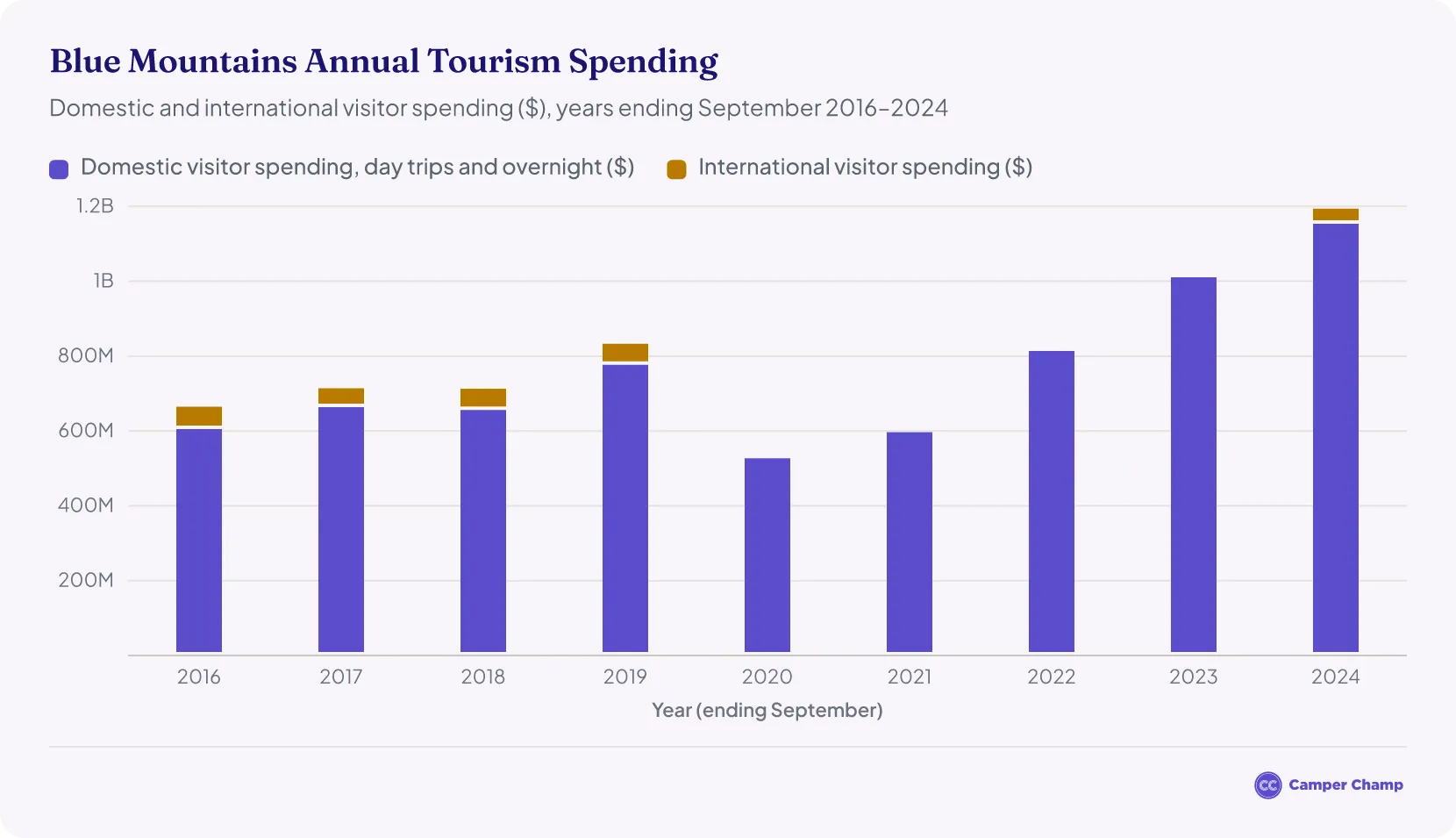
- Total visitor spending in the Blue Mountains (where the Three Sisters are located) was $1.194 billion in the year to September 2024, up 43.3% from the year to September 2019.5
- For the full regional breakdown of visitors, nights and spending, see Blue Mountains tourism statistics.
Where do Three Sisters visitors come from?
No visitor-origin count is published for the Three Sisters itself; the closest measure is the Blue Mountains region as a whole.
- Domestic tourists accounted for 98% of visitors to the Blue Mountains region in the year to September 2024.5
- International tourists (2%) numbered 84,000 in the year to September 2024. The top origins were the USA (15,000) and the UK (13,000); the figure for New Zealand, the third-largest, is not publishable.5
How do you get to the Three Sisters from Sydney?
The Three Sisters are seen from Echo Point lookout in Katoomba. From Sydney, take the Great Western Highway (M4 and A32) towards Katoomba, turn left off the highway at the Katoomba traffic lights, then follow the signs to Three Sisters and Echo Point.6
How long do you need at the Three Sisters?
- About two in three visitors to the Blue Mountains region come on a day trip: 2.97 million of 4.34 million in the year to September 2024, most of them (2.57 million) from Sydney.5
- Domestic overnight visitors stay about 2.3 nights on average in the Blue Mountains (year to September 2024).5
- The short Three Sisters walk follows a gently sloping 400m path from Echo Point to Oreades lookout, with steps a further 50m to Lady Game lookout for a closer view.3
When is the Three Sisters busiest?
The peak season at the Three Sisters is during the summer months.
- High visitor numbers during the Summer (December – February) because of holiday travel.3
- Spring (September – November) and Autumn (March – May) are also popular due to mild weather.
When is the best time to visit the Three Sisters?
Why are the Three Sisters so famous?
- The Three Sisters are three weathered sandstone peaks rising from the cliffs of the Jamison Valley. From Echo Point you can also see the Ruined Castle and Mount Solitary.4
- They stand on the land of the Gundungurra and Darug People, and the site is a declared Aboriginal Place. There are different versions of the Aboriginal story of the Three Sisters.4
- The Giant Stairway descends 998 stairs from Echo Point to Honeymoon Bridge, which connects to the first sister.7
- The Three Sisters are part of the Greater Blue Mountains Area, a UNESCO World Heritage Site.4
Where can you camp near the Three Sisters?
The most popular camping options in the area are:
- Tent camping at designated sites
- RV and campervan camping
- Glamping (luxury camping)
Campervan hire in Australia
Three Sisters FAQs
Can you walk to the Three Sisters?
Yes. The short Three Sisters walk starts at the archway next to the Echo Point Visitor Centre and follows a gently sloping 400m path to Oreades lookout. From the top of the Giant Stairway, a short but very steep set of stairs leads to Honeymoon Bridge, which connects to the first sister.3
Is the Three Sisters lookout wheelchair accessible?
Mostly. The top lookout platform at Echo Point is wide, flat and step-free, with gently sloping concrete paths to the lower lookout, 5 accessible parking spaces and accessible toilets.6 The Three Sisters walk is accessible with assistance as far as Oreades lookout, but reaching Honeymoon Bridge involves steep stairs.3
Do you have to pay to park at Echo Point?
Yes. There is a bitumen carpark near Echo Point, but time limits and parking fees apply, and spaces can be limited on weekends.6
Can you bring a dog to the Three Sisters?
No. Pets and domestic animals are not permitted, apart from certified assistance animals.6
Can you fly a drone at the Three Sisters?
No. Flying a drone for recreational purposes is prohibited in this area, and commercial filming or photography needs prior permission.6
What are the Echo Point Visitor Centre opening hours?
The Echo Point Visitor Centre is open daily from 9am to 4pm and closed on Christmas Day.4 The lookout itself is part of the Katoomba area, which is always open, though some spots can close for maintenance, poor weather or fire danger.
More national park statistics
- Blue Mountains Tourism Statistics
- Freycinet National Park Tourism Statistics
- Kakadu National Park Tourism Statistics
- National Park Statistics in Australia
- Uluru-Kata Tjuta National Park Tourism Statistics
- Wildlife Statistics in Australia
References
- Three Sisters success — LG Focus (November 2015) · lgfocus.com.au ↑ b c d
- Blue Mountains tourism surges post-COVID — Blue Mountains Gazette · bluemountainsgazette.com.au ↑ b
- Three Sisters walk — NSW National Parks and Wildlife Service · nationalparks.nsw.gov.au ↑ b c d e f g h
- Echo Point lookout (Three Sisters) — NSW National Parks and Wildlife Service · nationalparks.nsw.gov.au ↑ b c d e
- Travel to Blue Mountains Tourism Region — time series, year ended September 2024 (Destination NSW; TRA National & International Visitor Surveys) · destinationnsw.com.au ↑ b c d e
- Echo Point lookout (Three Sisters) — Visitor info — NSW National Parks and Wildlife Service · nationalparks.nsw.gov.au ↑ b c d e f g h
- Giant Stairway — NSW National Parks and Wildlife Service · nationalparks.nsw.gov.au ↑ b
- Tourism Figures in Three Sisters — Blue Mountains City Council · bmcc.nsw.gov.au