

Updated
At a glance
- 2.6 million people visited the Blue Mountains in the year to June 2026, around 7,200 a day1.
- Visitors spent $1.22 billion.1
- The region is part of the Greater Blue Mountains UNESCO World Heritage Area2, and Blue Mountains National Park is one of the most visited national parks in Australia.
- Figures before 2025 (such as 4.34 million in 2024)3 come from an older survey, so they cannot be compared directly with the latest year.
How many people visit the Blue Mountains each year?
About 2.6 million people visited the Blue Mountains in the year to June 20261.
Note: Tourism Research Australia started a new domestic survey in 2025, so this figure cannot be compared with the earlier years below, which come from the old survey (years ending September):
- 2025: no figure available. The new survey's data only starts in January 2025, so the latest report has no total for the year to June 2025.1
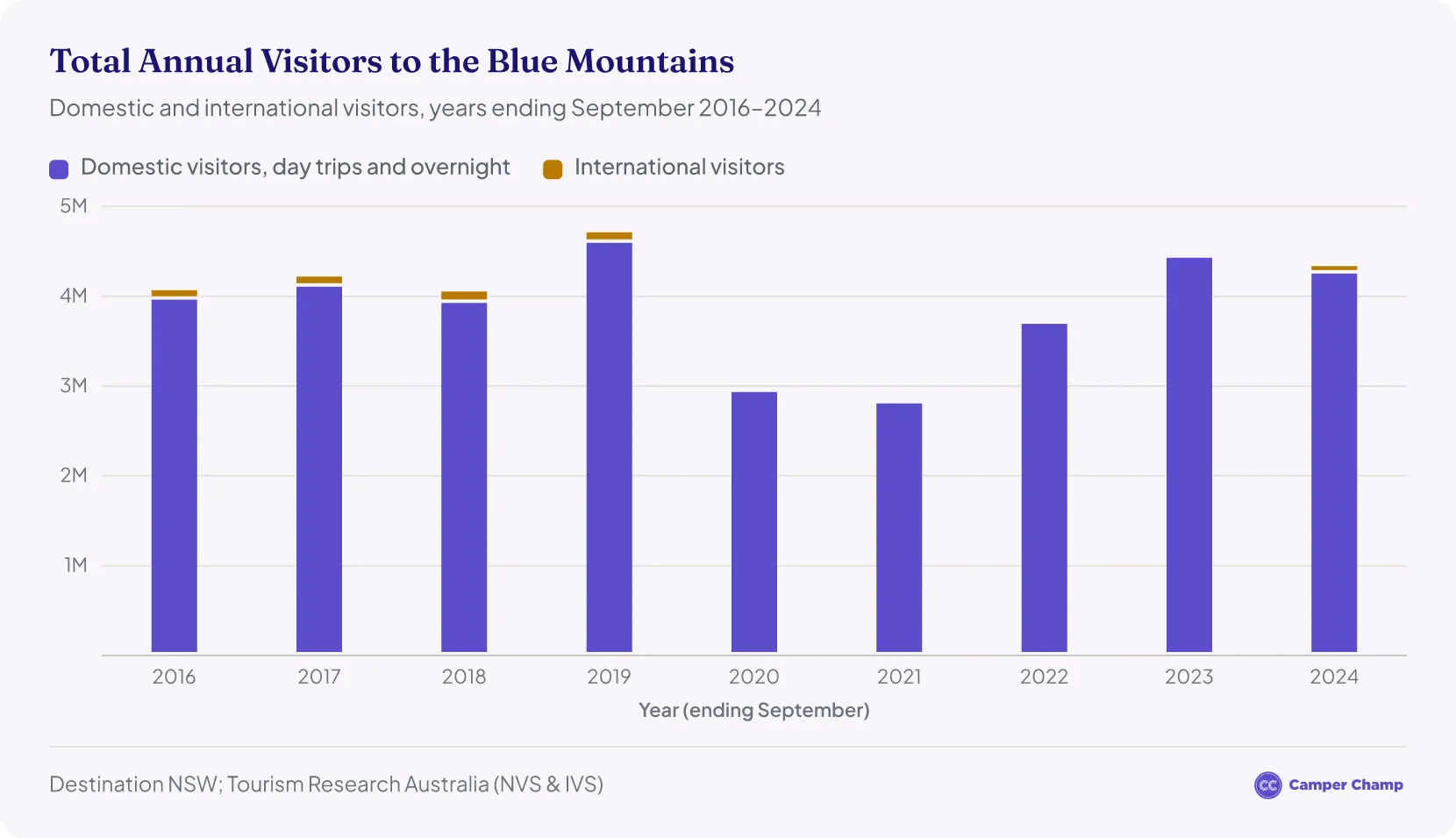
- 4.34 million people visited the Blue Mountains in 2024, an 8.0% decline from 2019’s peak numbers (4.71 million)3 but a recovery from the pandemic lows of 2020–2022.
- 4.43 million domestic visitors in 2023, a 20% increase from 20223 (international figures for 2020–2023 were not published).
- 4.71 million in 2019 (highest record pre-pandemic)3.
How many people visit Blue Mountains National Park?
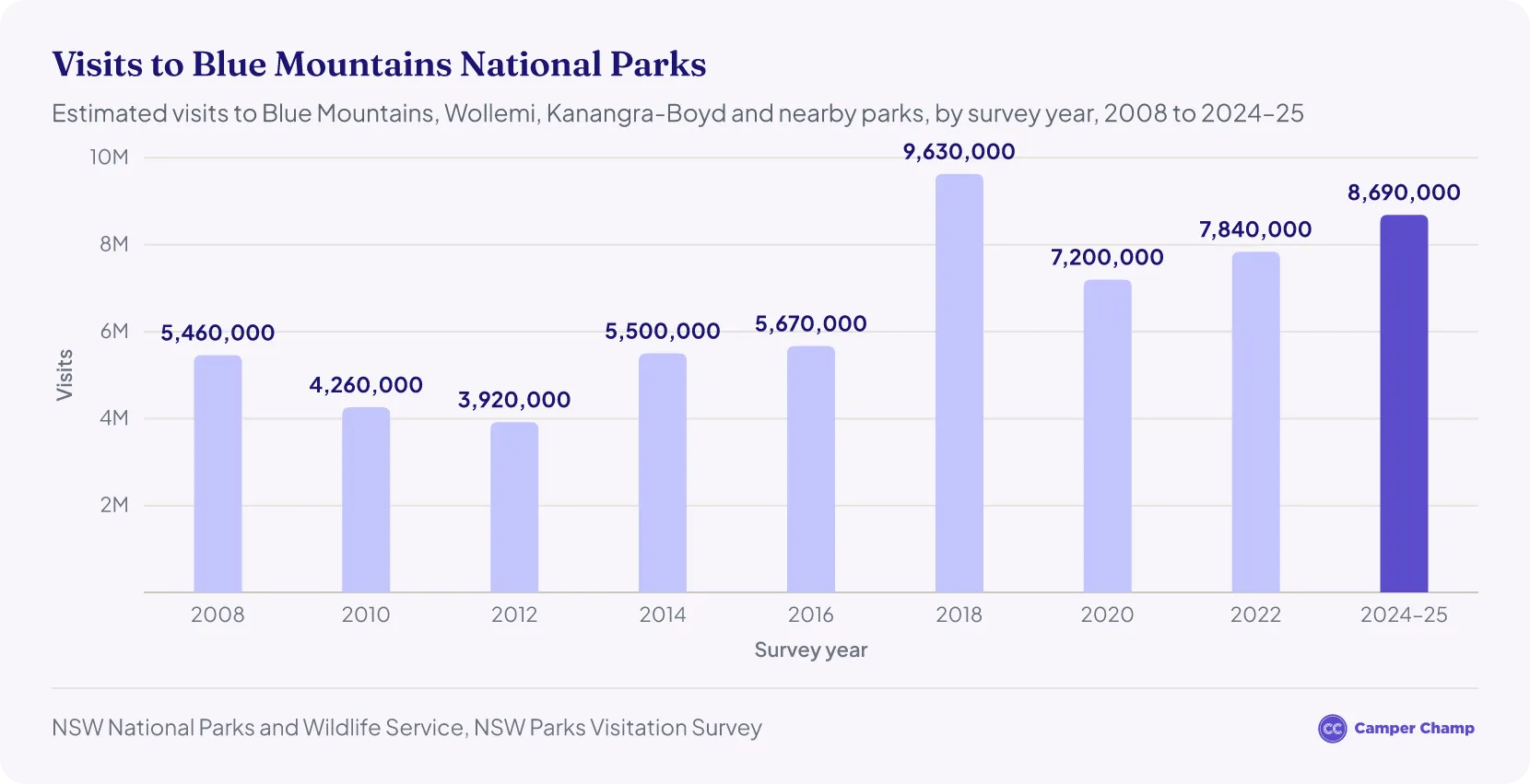
Blue Mountains National Park is the most visited national park in NSW, with about 7.8 million visits in 2024–25, well ahead of Royal National Park (4.9 million).4
- The figure counts visits, not people, so one person making three trips counts three times.5 It comes from a different survey from the tourism-region figures above, so the two don't match.
- The wider Blue Mountains parks area (including Wollemi and Kanangra-Boyd national parks) had about 8.69 million visits, and 95% were made by people living in NSW.4
- Visits to the area have grown from 5.46 million in 2008 to 8.69 million in 2024–25.4
- For 52% of visits, the park was the only or main reason for the trip.4
How much do tourists spend in the Blue Mountains each year?
Visitor spending in the Blue Mountains contributes significantly to the local economy.
- 2025: no figure available. The new survey's data only starts in January 2025, so the latest report has no spending total for the year to June 2025.1
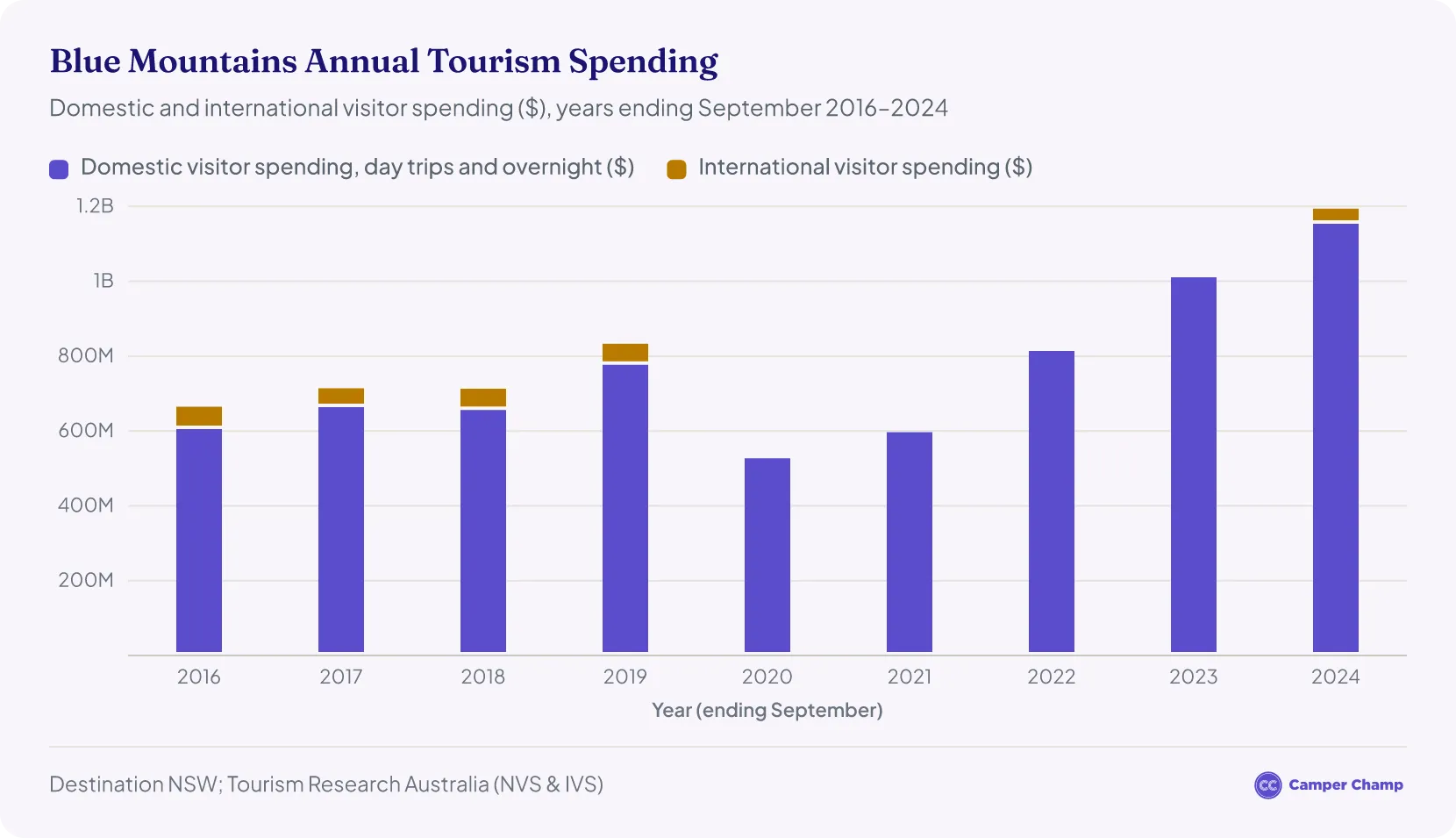
- Visitors spent approximately $1.194 billion in 2024, a 43.3% increase from 2019 ($833 million)3.
- $1,011 million in domestic spending in 2023, a 24.2% increase from 20223.
- $833 million in 2019, a 25.3% increase from 2016 ($665 million)3.
- $527 million in domestic spending in 20203 due to travel restrictions during 2020–2021.
Blue Mountains tourism statistics 2026: visitors, nights and spending
Destination NSW's latest release covers the year to June 2026. Tourism Research Australia started a new domestic survey in 2025, so these figures can't be compared with the earlier years above.
- 2.63 million visitors: 2.55 million domestic and about 80,000 international1.
- 1.43 million domestic day trips and 1.12 million domestic overnight visitors1.
- 2.68 million visitor nights1.
- Visitors spent $1.22 billion: $872 million by domestic overnight visitors, $304 million by day-trippers and $46 million by international visitors1.
- 71% of domestic overnight visitors came from Greater Sydney6.
Where do Blue Mountains visitors come from?
Most Blue Mountains visitors are Sydneysiders on a day trip or a short break. In the year to June 2026:
- 88% of domestic day-trippers and 71% of domestic overnight visitors came from Greater Sydney, and the rest of NSW made up 19% of overnight visitors.6
- Day trips were the most common kind of visit: 1.43 million day trips (54% of all visitors)1, compared with 1.12 million domestic overnight visitors (42%) and about 80,000 international visitors (3%).6
- A holiday was the main reason for 73% of day-trippers and 64% of overnight visitors, and about a quarter came to visit friends or relatives.6
- Overnight visitors most often travelled as an adult couple (34%), while 18% were families with children.6
- The UK was the top international market (22%), and 55% of international visitors were on their first trip to Australia.6
How many people visited the Blue Mountains in 2024?
- 4.34 million people visited the Blue Mountains in 20243. Domestic visitors (4.25 million) were down 4.0% on 2023 (4.43 million), but still a strong recovery from the pandemic years.
How many people visit the Blue Mountains per day?
- On average, around 7,200 people a day visited the Blue Mountains in the year to June 20261, though this varies by season.
How much do visitors to the Blue Mountains spend on average?
- In the year to June 2026, domestic overnight visitors spent about $781 per trip ($370 a night)6, day-trippers $212 and international visitors $580 per visit.
How many international tourists visit the Blue Mountains?
Many international tourists visit the Blue Mountains, and the top source market has changed in recent years:
- UK visitors outnumbered US visitors every year from 2015 to 2019, peaking at 23,000 (about 18%) in 2018.3
- USA visitors took the lead in 2024 with 15,000 visitors (about 18%), ahead of the UK (13,000).3
- The UK was back on top in the year to June 2026, with about 22% of international visitors6.
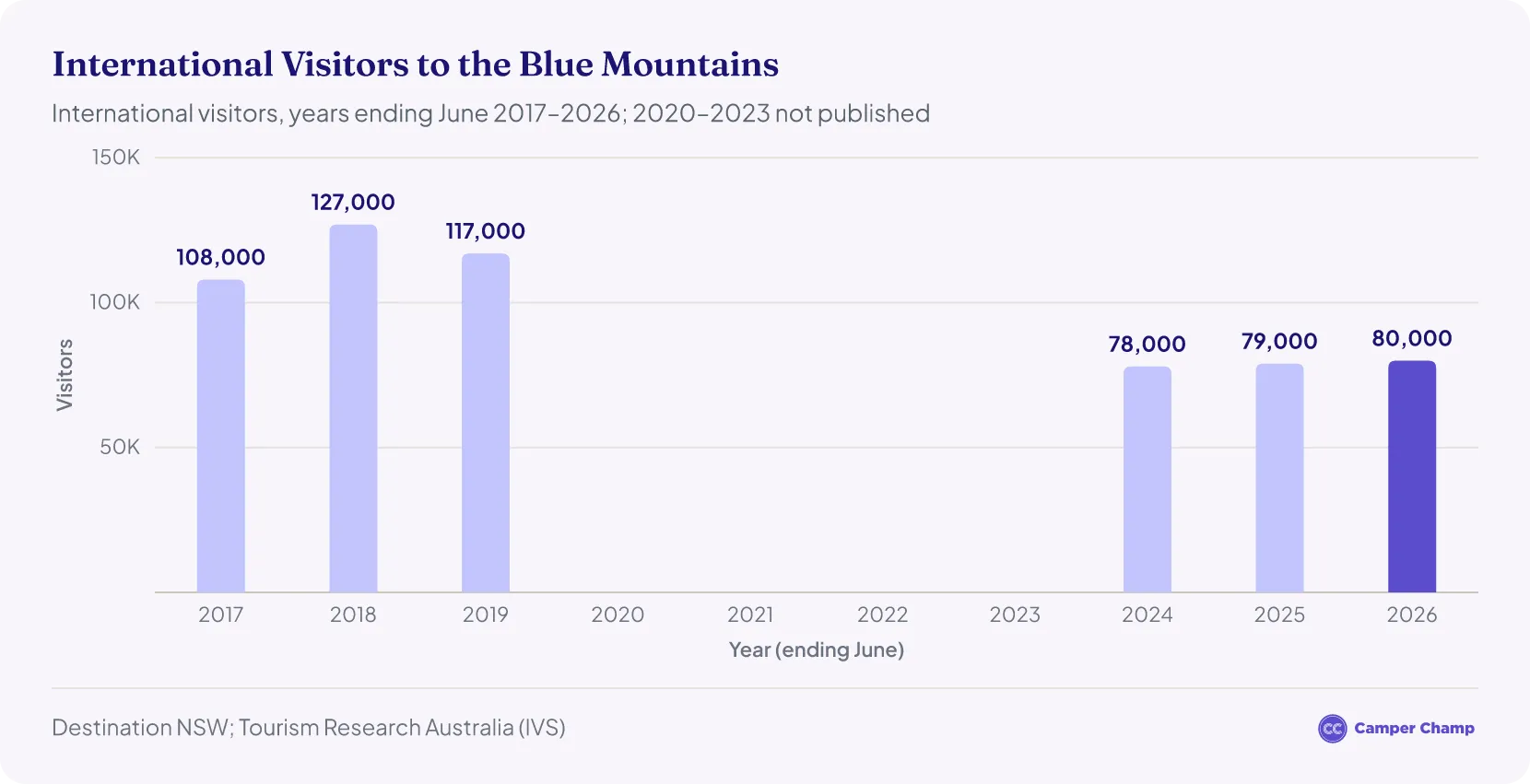
About 80,000 international visitors came in the year to June 20261, up slightly from about 79,000 in the year to June 2025, but still below pre-pandemic levels of over 100,000. International visitors spent $46 million in the year to June 2026, up from $38 million in the year to June 2025.
How long do tourists stay in the Blue Mountains?
- In the year to June 2026, domestic overnight visitors stayed 2.1 nights on average in the Blue Mountains, and international visitors 4.0 nights1.
When is the peak season in the Blue Mountains?
Peak season varies based on weather and travel patterns. Destination NSW does not publish a seasonal split for all visitors, but for international visitors in the year to June 2026, January – March was the busiest quarter:6
- July – September: 23%
- October – December: 26%
- January – March: 36%
- April – June: 15%.
For the national park, NSW National Parks found that visits to Blue Mountains parks peaked in autumn in 2024–25.4
When is the best time to visit the Blue Mountains?
- Spring and autumn have the best weather, views and quietness.
- Summer is usually busier due to school holidays.
- Winter is for those who love crisp mountain air and festivals.
Most visited attractions in the Blue Mountains
Blue Mountains National Park is the most visited national park in NSW with about 7.8 million visits in 2024–25.5 The most popular attractions include:
- Three Sisters – famous rock formation with great views
- Scenic World – cableway, railway and skyway7, with over a million visitors a year8
- Jenolan Caves – one of the oldest cave systems in the world9. Cave visits topped 68,000 in 2023–2410, but the caves were closed in 2024–25 for repair works and are expected to reopen in some form in 202611
- Wentworth Falls – waterfall and bushwalking trails
- Blue Mountains Botanic Garden – native and exotic plants.
What type of camping is most popular in the Blue Mountains?
- Caravan and campervan sites are a popular choice for campers and hikers. Interstate and overseas visitors can rent a campervan in Sydney to drive to the Blue Mountains.
- Eco-lodges are also a popular option.
Campervan hire in Australia
- Adelaide campervan rental
- Alice Springs
- Brisbane motorhome hire
- Cairns campervan rental
- Campervan hire in Broome
- Campervan hire in Darwin
- Campervan hire in Devonport
- Campervan hire in Hobart
- Campervan hire in Sydney
- Campervan hire in Tasmania
- Gold Coast
- Launceston
- Melbourne
- Perth motorhome hire
How many bushwalkers get lost in the Blue Mountains? Safety tips
About 130 bushwalkers get lost or need rescuing in the Blue Mountains area every year.12 Most are found within 24 hours.
- Don’t stray from marked trails to prevent accidents.
- Plan ahead by checking weather conditions.
- Carry enough water and hiking supplies.
- Follow park regulations.
- Let someone know about your plans, especially when exploring remote areas.
- Carry a personal locator beacon (PLB) to use as a last resort, and fill in a trip intention form before remote walks.12
More national park and nature statistics
- Freycinet National Park Tourism Statistics
- Kakadu National Park Tourism Statistics
- National Park Statistics in Australia
- Three Sisters Tourism Statistics
- Uluru-Kata Tjuta National Park Tourism Statistics
- Wildlife Statistics in Australia
References
- Travel to Blue Mountains Tourism Region — time series, year ended June 2026 (Destination NSW; TRA Domestic Tourism Statistics & International Visitor Survey) · cdn.sanity.io ↑ b c d e f g h i j k l m
- World Heritage Places – Greater Blue Mountains Area, DCCEEW · dcceew.gov.au ↑
- Travel to Blue Mountains Tourism Region — time series, year ended September 2024 (Destination NSW; TRA National & International Visitor Surveys) · destinationnsw.com.au ↑ b c d e f g h i j k
- NSW Parks Visitation Survey: FY24-25 Annual Report · environment.nsw.gov.au ↑ b c d e
- Record visits to NSW national parks drives economic growth and regional jobs · nsw.gov.au ↑ b
- Blue Mountains Visitor Profile — year ending June 2026 (Destination NSW; Tourism Research Australia) · cdn.sanity.io ↑ b c d e f g h i
- Scenic World Blue Mountains · scenicworld.com.au ↑
- Who we are – Scenic World · scenicworld.com.au ↑
- Australian Geologists Date World's Oldest Discovered Open Caves At 340 Million Years · sciencedaily.com ↑
- Jenolan Caves Reserve Trust Annual Report 2023-24 · jenolancaves.org.au ↑
- Jenolan Caves Reserve Trust Annual Report 2024-25 · jenolancaves.org.au ↑
- Think Before You TREK – bushwalking safety · nationalparks.nsw.gov.au ↑ b
- Blue Mountains Tourism Data · bmcc.nsw.gov.au
- Blue Mountains Statistical data · destinationnsw.com.au